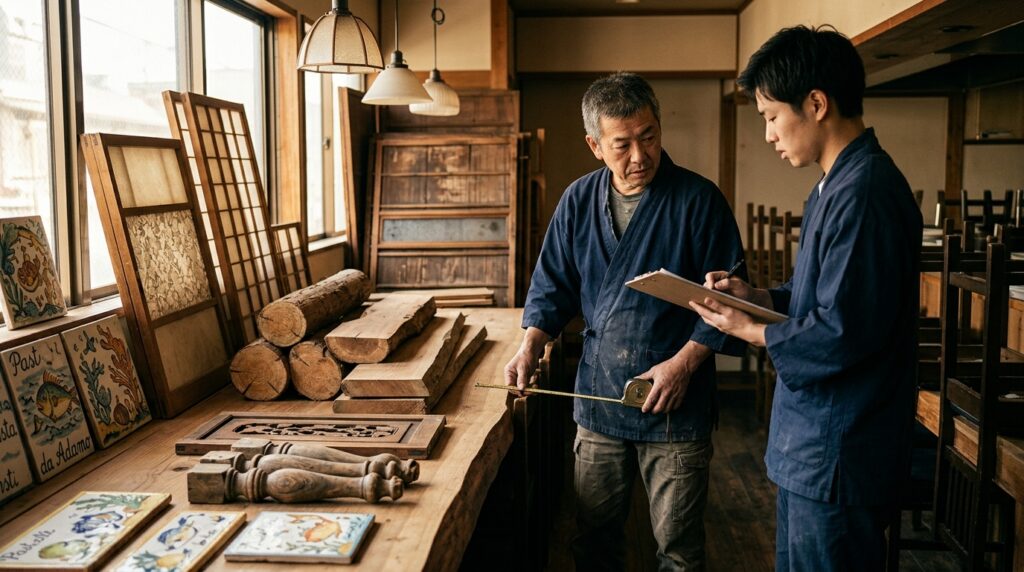
Closing, relocating or renovating a restaurant means real cost and effort to dispose of the interior and fixtures. Yet much of what would simply be demolished and thrown away is, in fact, still very much sellable.
Doors and counters and other fittings, chairs and tables, showcases and shelving, Japanese chests, antiques and lighting — even fixtures such as grease traps: if the condition is good, they qualify for buyback, letting you turn a cash return while cutting your disposal costs.
This guide lays out the big picture of buyback when you close or renovate — the cost structure to understand before you throw anything away, the essential checks before you sell, the order versus restoration, and the timing that lifts your valuation — all from a practical point of view.
“Throwing away” and “selling” have completely different cost structures
Buyback of interior materials means selling the fittings, furniture, fixtures and equipment you no longer need after a closure or renovation — cutting your disposal costs while turning them into cash.
When you “dispose of” an unwanted interior, the cost only ever flows one way:
- Demolition and removal: taking out built-ins, plus the labour to carry it all out.
- Industrial-waste disposal: wood, metal and mixed waste must be disposed of as industrial waste by a licensed handler, with a waste manifest (the control slip proving proper disposal).
- Haulage: transport to the disposal site.
Buyback reverses this flow. Have the sellable items taken first, and you get a double effect: (1) less to dispose of (lower disposal cost) and (2) cash from the sale. Money that was destined to leave as a disposal cost turns into income — that is the essence of buyback.
Confirm “ownership” before you sell
The first place people trip up in buyback is the question of ownership: “Is this actually mine to sell?” Always confirm the following before selling.
- Leased or rented items: some equipment, such as an ice machine, may be on a lease. If there is an outstanding lease balance, you cannot sell it. Check the contract.
- Left-behind property: items the previous tenant left (leftover property) are not necessarily yours. Confirm with the landlord or management company.
- Built-ins and owner-supplied items: built-in work fixed to walls or floors (a built-in counter, say) is a “remove and sell” or “leave in place” decision that depends on your restoration obligation.
- The lease terms: your lease may set terms for handing over or buying out fixtures.
Skip this and you risk trouble after the sale. It is safest to start from what is movable and clearly your own property.
The rule: sell before you restore
An easily overlooked point at move-out is the order of selling and restoration (returning to bare shell).
A restoration obligation is the duty, at the end of the lease, to return the space to the state you leased it in — often by demolishing the interior back to a bare shell. Demolish first, and the fittings, fixtures and equipment you could have sold get thrown out along with everything else.
The correct order is (1) valuate and sell what’s sellable → (2) demolish and restore the rest. Reducing the volume through buyback first also shrinks the later demolition and industrial-waste costs — a double win. Once your move-out schedule is set, the standard move is to get a buyback valuation before you engage a demolition contractor.
The timing and condition that raise your valuation
Even the same materials are valued differently depending on when, and in what condition, they’re assessed.
- Move early: while things are still in good shape, right after closing. The more they sit and deteriorate, break or grow mould, the lower the valuation.
- Fixtures, while they’re still “live”: while the electricity, gas and water are still connected, you can check that lighting comes on, that exhaust fans and hoods run, and the state of taps and the grease trap — a confirmed-working item values better.
- Clean it up: simply removing dust and grease changes both the impression and the valuation.
- Gather the accessories: shelves, screws, remotes and assembly parts being present makes markdowns less likely.
Where to sell — which route pays best
There are several places to sell, each strong in different areas.
- A specialist interior-materials store (buyback): handles restaurant fittings, furniture, fixtures, décor and equipment across the board, and its strength is taking it all together, on-site. With resale channels in place, items are more likely to be valued.
- Recycle shops: centred on general household goods; specialist restaurant fixtures and equipment often struggle to get a valuation.
- Demolition contractors: they’ll demolish, but “selling” isn’t their mindset, so usable materials tend to be scrapped.
- Flea-market apps and auctions: a single item may sell high, but you carry the removal, packing, correspondence and delivery of large items yourself.
If you’re parting with fittings, fixtures and equipment all at once, a buyback store that specialises in restaurant materials is the stronger choice on both effort and disposal cost.
How buyback works
A specialist store’s buyback generally runs as follows.
- Enquiry: tell them the items, quantities and your move-out / construction schedule.
- Photo valuation: photos of the main items confirm what’s eligible and a rough guide.
- On-site valuation: condition, quantity and the carry-out route are checked on site.
- Collection: large items are removed and loaded by large truck.
- Payment.
The clearer your schedule, the easier it is to arrange — so once your move-out or start date is set, an early enquiry works in your favour.
[Comparison] Disposal vs. general recycling vs. specialist buyback
| Item | Disposal (demolition) | General recycling | Specialist interior buyback |
|---|---|---|---|
| Direction of cost | Outgoing only (demolition, waste) | Buy / free / paid, item by item | Buyback = income + less to dispose of |
| Restaurant fixtures & equipment | No value (scrapped) | Hard to value | Valued via specialist channels |
| Fittings, folk antiques, décor | Scrapped | Some only | One-of-a-kind and design valued |
| Removal | Demolition contractor | Mostly drop-off | On-site, large-truck handling |
| Effort | Easy to demolish in one go, but all scrapped | Handle each item yourself | Valued and collected together |
Tax treatment (please confirm)
Selling or writing off business assets can involve a gain on sale or a loss on disposal in your books and tax return. Because the treatment depends on your business structure and how the assets are recorded, confirm the details with a tax accountant or your local tax office (this article is general guidance only).
For the detail by item, see the individual guides
“What exactly sells,” and “how fittings and fixtures are assessed,” are covered item by item in these articles.
- What sells? The buyback checklist and valuation points →
- Selling fittings, fixtures and décor — pillars, doors, grease traps and more →
Tenpos Kawaguchi buys back restaurant interior materials — fittings, furniture, fixtures, décor and equipment — from a single item to a whole restaurant. Valuation and consultation are free, with on-site pickup by large truck. Once your closure or renovation is decided, talk to us before you demolish.
Request a buyback valuation → More about buyback →