The value most often overlooked in a restaurant interior lies in the fittings (pillars, doors, counters), the décor such as folk antiques and antiques, and fixtures such as grease traps. Too often, owners assume “this is built-in” or “fixtures are for the skip,” and demolish and scrap the lot.
Yet these are exactly the categories Tenpos Kawaguchi handles as its core buyback business. This article digs into the valuation points for fittings, fixtures, décor and equipment, along with the cautions for removal and carry-out. (For the big picture, see the complete buyback guide; for the item list, What sells?)
Fittings and materials (pillars, doors, sliding doors, counters)
Fittings are a category with steady, strong second-hand demand. A valuation looks at:
- With frame, or door-only: doors and sliding doors with their frame (head jamb, sill, door frame) offer wider reuse and value better. A door alone needs joinery to refit, and that effort shows in the valuation.
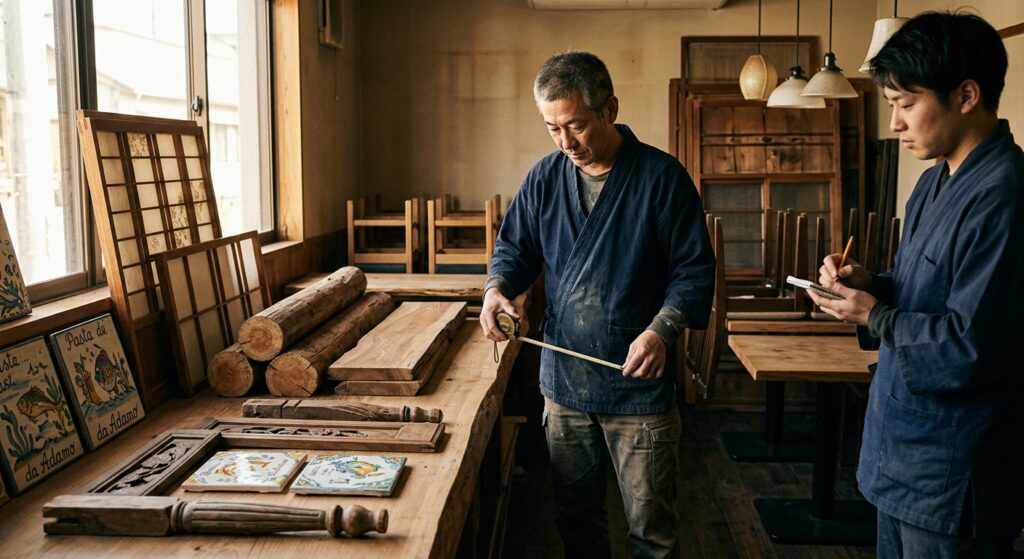
- Solid or reclaimed wood: single-plank solid wood, reclaimed pillars and beams, and characterful fittings are valued for their design.
- Design and one-of-a-kind: lattice doors, transoms and old-design doors can carry value that mass-produced items don’t.
- Size and condition: the closer to standard dimensions, the easier to find a reuse home. Warping, cracks and a dropped fit are markdown factors.
- Counters, partitions, screens: movable and free-standing pieces value well; a large wall-fixed built-in depends on whether it can be removed and relocated intact.
Fixtures, storage and furniture (showcases, shelving, chests)
- Showcases and till counters: size, cracked or chipped glass; for refrigerated ones, a working test affects the valuation.
- Shelving, pantry units, office equipment: accessories such as adjustable shelves, and whether the size is versatile.
- Japanese chests and furniture: material, build and condition. A matched set helps.
Décor, folk antiques and antiques (the value of one-of-a-kind)
In this field, “old” does not mean “cheap.” The axes of valuation are design, rarity and maker.
- Folk antiques, ornaments, paintings (wall art), signage, foliage: a one-of-a-kind piece with real character can carry value mass-produced goods don’t.
- Antique furniture: condition, of course, but era, style and material drive the value.
- Lighting and chandeliers: design and a lighting test. Complete accessories (bulbs, canopy, chain) help.
The harder an item is to judge, the more a photo consultation is the quick route.
Fixtures/equipment (grease traps, hoods, pressure fans, taps)
Fixtures are often assumed to be “for the skip,” but in good condition they qualify for buyback. Here the valuation is heavily influenced by the state of removal and disconnection.
- Grease trap: size, material, cleanliness. The more grease and dirt removed, the better the impression.
- Hoods, exhaust / pressure fans: size, motor operation, degree of grease. A working test while still live helps.
- Taps and related fittings: spec and condition.
- Removal and pipe disconnection: disconnecting water, drainage and gas is work for a licensed tradesperson or specialist. Forcing something off and damaging it harms both value and safety, so discuss the removal method in advance.
About kitchen equipment (a note)
We can handle buyback of kitchen equipment too, but our focus is fittings, furniture, fixtures, décor and equipment such as the above. Eligibility and terms for appliances vary by item, so please check with us first — a photo is the quickest way.
Cautions for removal and carry-out
- Check the carry-out route: for large fittings and fixtures, confirm the doorway, stairs, lift and any steps in advance.
- Fixed items: for wall- or floor-fixed pieces, whether they can be removed without damage decides both value and eligibility.
- Licensed work: disconnection involving electricity, water/drainage or gas goes to a specialist.
- Order: get the valuation before demolition and restoration (details in the complete guide).
[Comparison] Demand × valuation points, by item group
| Item group | Second-hand demand | What the valuation looks at |
|---|---|---|
| Fittings (doors, sliding doors, transoms, lattice) | High | With frame / door-only, solid/reclaimed wood, design, warping |
| Pillars, beams, materials | Medium–high | Solid/reclaimed wood, size, condition |
| Counters, partitions, screens | High | Movable/free-standing vs. fixed built-in, size |
| Fixtures, chests, showcases | High | Size, accessories, function (e.g. refrigerated) |
| Folk antiques, antiques, lighting | Depends on design | One-of-a-kind, rarity, lighting test |
| Fixtures/equipment (grease trap, hood, taps) | Medium | Condition, size, state of disconnection |
Parting with it all? Start with a consultation
The least effort is to put fittings, fixtures, décor and equipment to an on-site valuation all together. Tenpos Kawaguchi buys back from a single item to a whole restaurant, with free valuation and consultation and large-truck removal. Talk to us before you demolish.
Request a buyback valuation → More about buyback →