
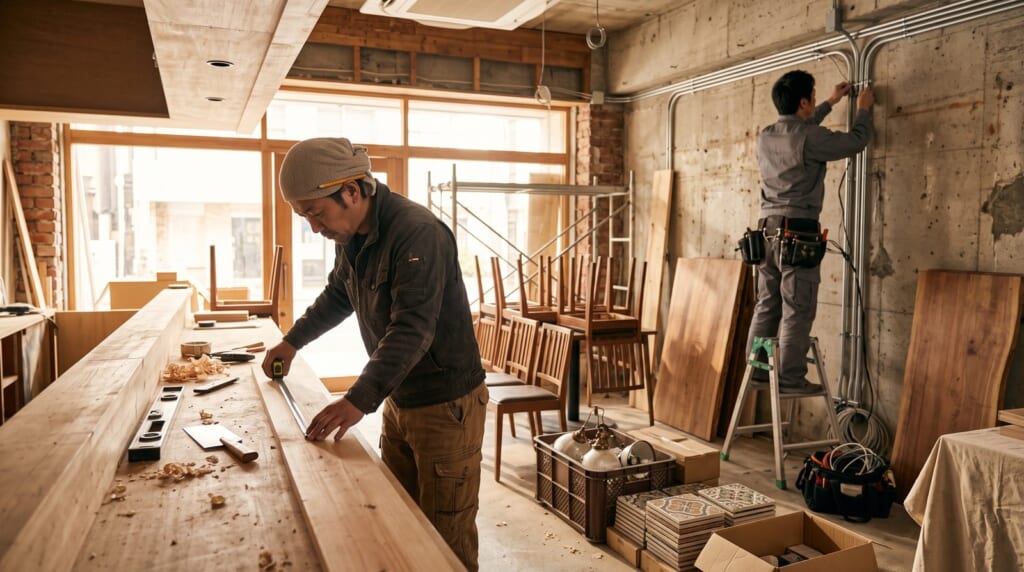
If you want the restaurant you have in mind without overspending on the fit-out, the fastest route is to split the work you can do yourself from the specialist work that needs a licence. In Japan, electrical, water supply, drainage, gas and fire-protection work is restricted by law to licensed or designated contractors — so hand just those trades to a craftsman, and take on painting and furniture assembly yourself.
Doing everything yourself risks straying into licensed work, which can mean breaking the law or causing an accident. Handing everything to one contractor, on the other hand, pushes the cost up. We covered the cost side in “How Much Should You DIY? Hybrid DIY”.
This article focuses on who to hire, for what, and how to brief them: where the licensing lines fall, how to commission a craftsman, the order of works, and the pitfalls of splitting a job — all from a practical point of view.
What you can do yourself — and what needs a licence
Restaurant interior DIY means the owner carries out work such as painting or assembling shelving themselves, rather than handing everything to a contractor. Electrical, water, drainage, gas and fire-protection work must, as a rule, be done by licensed or designated contractors; finishing work such as painting, wallpapering and furniture assembly needs no licence.
| Type of work | Examples | Who can do it | Relevant law | Can you DIY it? |
|---|---|---|---|---|
| Electrical | Adding or moving outlets, replacing wall switches, lighting circuits, distribution board work | A licensed electrician (depending on how the building takes its power supply, a Class 1 electrician or equivalent may be required) | Electricians Act | No (except “minor work” such as plugging in, or connecting a cord to a plug-in connector or socket) |
| Water supply | New, extended or relocated supply pipes; additional taps | A “designated water supply installer” appointed by the local water utility | Water Supply Act; the utility’s ordinances and rules | No (except “minor changes” with no pipework, such as replacing a single tap or swapping washers and seals) |
| Drainage | New, extended or relocated drain pipes; altering drainage fixtures | In most municipalities, a “designated drainage contractor” appointed by the city or town | Sewerage Act; the municipality’s sewerage ordinance | No, in most municipalities (a plan approval may be required before work starts) |
| Gas | Extending gas lines, adding gas outlets | City gas: the gas company or its designated contractor / LPG: a licensed LPG equipment installer | Gas Business Act; LP Gas Act | No |
| Fire protection | Automatic fire alarm systems, sprinkler systems | A Class A fire-protection equipment engineer (a notice of works must be filed with the fire station before starting) | Fire Service Act | No |
| Carpentry & joinery | Fitting shelves, assembling tables and chairs, simple partitions | No licence needed | Building Standards Act; Fire Service Act (*1) | Yes (check partitions in advance) |
| Interior finishes | Wallpapering, painting walls and ceilings, tiling | No licence needed | Building Standards Act (*2) | Yes (materials may be restricted) |
*1 Changing how rooms are divided can affect escape routes and the coverage of fire alarms and sprinklers. Before building any wall that reaches the ceiling, check with your local fire station and the building manager.
*2 Restaurants with an open-flame kitchen, or above a certain size, may be required to use non-combustible materials on walls and ceilings (interior finish restrictions). What you can use depends on the building’s construction, size and how each room is used, so check before you start.
* Exit signs are excluded from the work reserved for fire-protection equipment engineers, but because they involve wiring, a licensed electrician is still required. Check with your local fire station whether you need them and what notices to file (source: Nagoya City Fire Bureau, notices of works for fire-protection equipment (Japanese), checked 9 October 2026).
* Under the Fire Service Act, curtains, carpets and similar items used in restaurants must be certified flame-retardant products (source: Tokyo Fire Department, premises subject to flame-retardant rules (Japanese), checked 9 October 2026).
* The scope of “minor changes” to water supply is set by Article 13 of the Water Supply Act Enforcement Regulations (source: Ministry of Land, Infrastructure, Transport and Tourism, designated water supply installer scheme (Japanese), checked 9 October 2026). Example of a designated drainage contractor scheme: City of Yokohama, drainage plan approval (Japanese, checked 9 October 2026).
* In multi-tenant buildings, some areas can only be worked on by the building’s nominated contractor, whatever your licences. Check with the management company before starting.
How to hand just the specialist work to a craftsman
Splitting a job means hiring carpenters, electricians, plumbers and other trades directly, trade by trade, instead of handing the whole fit-out to one contractor. The key to avoiding trouble is to define exactly what you are asking for and to give accurate information about the site.
- Define the scope: decide where the craftsman’s work ends — for example, “the electrician runs the wiring and fits the outlets; I’ll place and hang the light fittings.” Even when you fit a light yourself, connecting it to the wiring is electrician’s work.
- Gather the information: site dimensions (frontage, depth, ceiling height) and the model numbers and spec sheets of the equipment or lights you plan to install (voltage, power draw, water inlet and drain positions).
- Record photos and measurements: take wide shots of the work area, close-ups of any exposed wiring or pipework, and shots with a tape measure in frame — and share them when you ask for a quote.
- Agree dates and sequence: draw up a simple schedule and share it in advance so your work and the craftsman’s don’t clash.
An example order of works for DIY and trades
The rule is services first — wiring and pipework — then finishes and assembly. Get the order wrong and you end up breaking into finished walls or floors to run cables, which costs time and money. Here is an example for a small café or izakaya.
- Strip-out and clear-up (you or a demolition contractor): remove unwanted fixtures, clean.
- Services first fix (licensed trades): electrical wiring, water, drain and gas lines.
- Framing and carpentry (a craftsman or you): partition framing, subfloor repairs.
- Interior finishes (you): painting walls and ceilings, wallpapering, flooring and tiling.
- Second fix and connections (licensed trades): fitting outlets and switches, connecting taps and equipment.
- Furniture and fixtures (you): placing tables and chairs, assembling shelving, hanging décor.
Pitfalls of splitting a job
When you hire trade by trade, it can become unclear whose work caused a problem when something goes wrong.
- Where rework happens: having to run cables through a wall you have already finished, or outlets and switches not sitting right because nobody told the electrician how thick the wall or tile finish would be. Finish your own work before the craftsman arrives, and tell them the finish thickness and positions in advance.
- Agree who is responsible for what: if there is a leak, you may end up arguing over whether the craftsman’s pipework or the part you fitted is to blame. Test water and power with the craftsman present, and keep a record of what was checked.
- Consult the public health centre and fire station first: take your plans to both before work starts. Requirements vary by municipality and building, so this avoids finishing the fit-out only to fail the standards and be refused a business licence. See “Pre-Consultation with the Health Centre & Fire Department” for details.
The reality of finishing in two weeks
With only two weeks or so to opening, building everything from scratch on site is not realistic — you need to work with what is already there and bring in finished pieces.
- Use the existing services and fit-out: moving wiring or water and drain lines can take time for applications and preparation. Keeping the counter and wet areas where they are is the realistic option.
- Use ready-made furniture and used materials: cutting, painting and drying bespoke joinery takes days on its own. Bringing in finished chairs and tables and freestanding fixtures shortens the programme.
- Book the trades early: electrical and plumbing connections can’t go ahead until a craftsman is free. Fix their dates at the same time as you order materials.
On the other hand, avoid cutting drying times (moving on before filler, paint or adhesive has dried leads to peeling and odours) and running several trades at once (in a small space, several craftsmen plus you get in each other’s way and everything slows down).
Need materials and craftsmen in one place?
At Tenpos Kawaguchi Interior Materials, you can talk to us about buying used restaurant interior materials and finding craftsmen at the same time. Everything we buy in is inspected, cleaned and repaired in our own workshop before it goes on sale, and anyone — trade or private — can buy. We can introduce independent craftsmen for every trade involved in a restaurant fit-out, anywhere in Japan, including just the trades you need, such as electrical work only. There’s no fee to you as the client, and quotes are free. You contract with and pay the craftsman directly.
Tell us your build schedule and we’ll agree how long to hold your materials. In store, you can also build a 3D plan of your restaurant with our staff, free of charge (by appointment).
Build your restaurant (craftsman introductions) → Ask about a craftsman →