
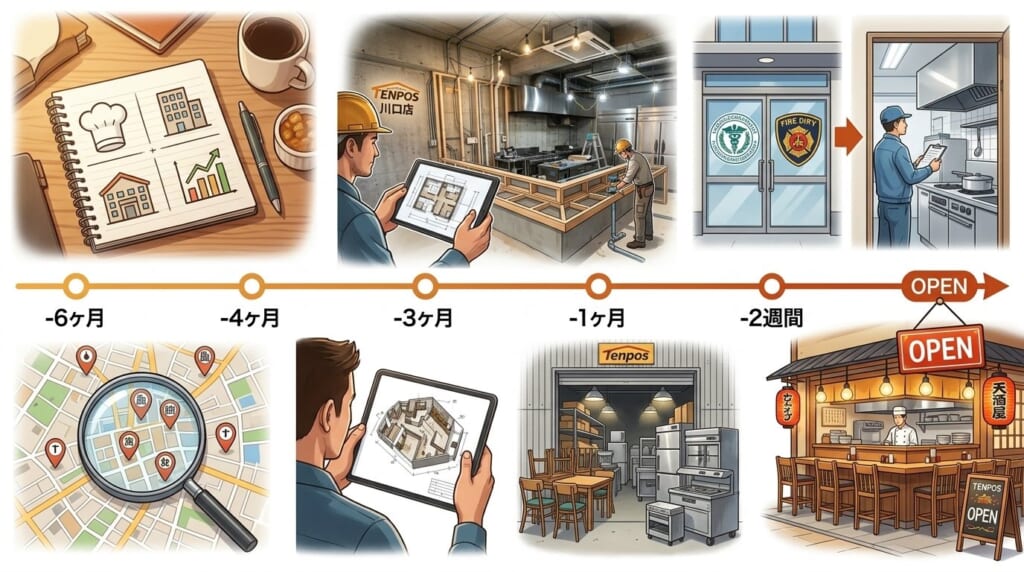
You’ve signed for the unit and already told friends the opening date. But you don’t know when to go to the public health centre, or by when the fit-out has to be finished. If the health centre flags something after the works are done and it has to be redone, you won’t make the opening. It’s a worry we hear often from people partway through preparing to open.
A restaurant opening schedule is built by fixing the opening day first and working back from it to the deadlines for permits and the time the fit-out takes. Get the order of works and paperwork wrong, and rework and waiting push the opening day back.
In this article, Tenpos Kawaguchi Interior Materials (Kawaguchi, Saitama; 1,254 m²) uses guidance from the public health centre and fire department in Kawaguchi, where our store is, as an example to set out a six-month schedule worked back from opening day, the order of permits and works, and the stages most likely to slip. In Japan, a restaurant needs a business licence from the local public health centre and must notify the fire department before it opens.
Why work back from the opening day?
You work back from the opening day because permit deadlines are set relative to the day you start trading or using the premises. In Kawaguchi, the business licence application is due at least two weeks before you start trading, and the fire department’s notice of start of use of the premises at least seven days before you start using them.
Working back from those deadlines fixes the date the fit-out must be finished, and from there the date works must start and the date you need to sign the lease. If you build forwards from signing the lease instead, you won’t know until the very end whether you’ll make the opening day if any stage overruns.
A six-month schedule worked back from opening day
The table below is an example schedule if you start preparing six months before opening. Durations vary with the unit’s condition and the size of the works, so enter your own opening day and fill in a date for each stage.
| Rough timing | What to do | Who to consult or apply to |
|---|---|---|
| 6–4 months before | Settle the concept and finance plan Look for units and get a rough fit-out estimate for each candidate If you’ll borrow, start talking to lenders | Lenders, fit-out contractors |
| 4–3 months before | Before signing, check the services capacity and the building’s works categories Draw up a floor plan and take it to the public health centre for a drawing consultation before works start Get fit-out quotes from at least two contractors | Public health centre, fire department, building manager, fit-out contractors |
| 3–1 months before | Carry out the fit-out Choose dining-room materials and furniture and arrange them to suit the works schedule Qualify as a food hygiene manager | Fit-out contractors, craftsmen, materials suppliers |
| At least 2 weeks before opening | Apply to the public health centre for a business licence Once the completion date is set, book the on-site inspection | Public health centre |
| At least 7 days before opening | Submit the notice of start of use of the premises to the fire department | Fire department |
| Just before opening | Pass the health centre’s on-site inspection and receive your licence Test-run the kitchen equipment and rehearse service | Public health centre |
| After opening | File a notice of commencement of business with the tax office (if opening as a sole proprietor) | Tax office |
* Deadlines are based on guidance from Kawaguchi City’s public health centre and fire department and the National Tax Agency. Deadlines and required documents vary by municipality, so check with the public health centre and fire department where your restaurant is.
Sources: Kawaguchi City, “Business licence application process”; Kawaguchi City, “Application forms (fire prevention ordinance)”; National Tax Agency, “Notice of commencement or cessation of a sole proprietorship” (all Japanese; checked 4 November 2026)
In what order do permits and works go?
When it comes to permits and works, finish the drawing consultation with the public health centre before the fit-out starts. Kawaguchi’s public health centre states that if the premises don’t meet the standards at the on-site inspection, it cannot issue a licence until they are put right. Find a problem only after the works are done, and you face remedial work, extra cost and a later opening all at once.
- Consult the public health centre with your drawings (before works start): Check that the number of sinks, hand-washing stations and floor and wall materials meet the standards.
- Carry out the fit-out: Build to the drawings you checked. If the drawings change, consult again.
- Apply for the business licence (at least 2 weeks before trading): Submit the application, the floor plan and proof of food hygiene manager qualification at the public health centre.
- Pass the on-site inspection (after completion): A food sanitation inspector from the public health centre visits to check that the premises match the application and meet the standards.
- Receive the licence and start trading
Notifying the fire department isn’t something to leave until the works are done, either. Wall and ceiling finishes may fall under the interior finish restrictions of the Building Standards Act, and depending on the floor area and capacity you may need fire safety equipment, so consult the fire department before choosing finishes and equipment to avoid rework.
How to approach the health centre and fire department in advance, and where inspections tend to trip people up, is covered in “Avoiding last-minute rework: consulting the health centre and fire department in advance”.
Which stages of preparation tend to slip?
The stages that tend to slip are the ones whose dates you can’t set on your own. Where another party is involved, you have to fit around their schedule and checks, so unless you start early, things jam up just before opening.
| Stage that tends to slip | Why it slips | What to do early |
|---|---|---|
| Handover and landlord-side works | The handover date and the schedule for works by the landlord’s designated contractor (B works) are set by the landlord or building manager | Before signing, check the handover date and the works categories |
| Services upgrades | Increasing electrical or gas capacity needs paperwork and work with the power or gas company | Before signing, compare your equipment’s requirements with the unit’s capacity |
| Remedial work after the health inspection | If anything falls short of the standards at the on-site inspection, no licence is issued until it’s put right | Finish the drawing consultation before works start |
| Sourcing materials and furniture | Getting enough matching chairs depends on stock, and many used pieces are one-offs | Start choosing materials once the layout and seat count are settled |
Ideally you would take delivery of materials as the works progress, but a restaurant under construction may have nowhere to store them. With used materials, a piece you like may be bought by someone else unless you secure it first, so treat choosing and taking delivery as separate steps.
Start by fixing your opening day and filling in the schedule, working back from the permit deadlines and the time the works take. Mark the stages that involve another party, and you’ll know who to contact this week.
How we can help with your schedule
Tenpos Kawaguchi Interior Materials helps owners open by cutting purchase costs with used materials, doing what they can themselves, and bringing in licensed tradespeople only for the work that needs them.
- Settle the layout before works start: Create a 3D floor plan with our staff in store, free of charge (by appointment; viewed on our in-store screen, and not an official drawing for health centre applications or similar).
- Choose now, collect later: Materials you choose after seeing them on our 1,254 m² floor can be held for a period agreed around your works schedule. Everything on the shop floor has been inspected, cleaned and repaired in our own workshop.
- Delivery to suit your schedule: Trucks up to 4 tonnes can load on site, and we deliver anywhere in Japan from the store (large items and some locations by arrangement).
- Bring in tradespeople only where needed: We introduce craftsmen only for licensed work such as electrical, gas, water and drainage (no introduction fee for clients, free quotes, and you contract and pay the craftsman directly).
Tenpos Kawaguchi Interior Materials
3-32-24 Sakashita-cho, Kawaguchi, Saitama / Open 10:00–19:00 every day (closed over the New Year holidays)
Tel +81-48-285-2027 / Parking available (trucks up to 4 tonnes, loading on site) / Payment: cash, card or PayPay
Talk to us about your build → Book a visit (materials, 3D plans) →
FAQ (schedule to opening)
Can I apply for the business licence before the fit-out is finished?
By when do I need the food hygiene manager qualification?
Do I have to file the notice of commencement of business within a month of opening?
When should I announce the opening date?
Source for the food hygiene manager requirement: Kawaguchi City, “Documents required for a new business licence application” (Japanese; checked 4 November 2026)