
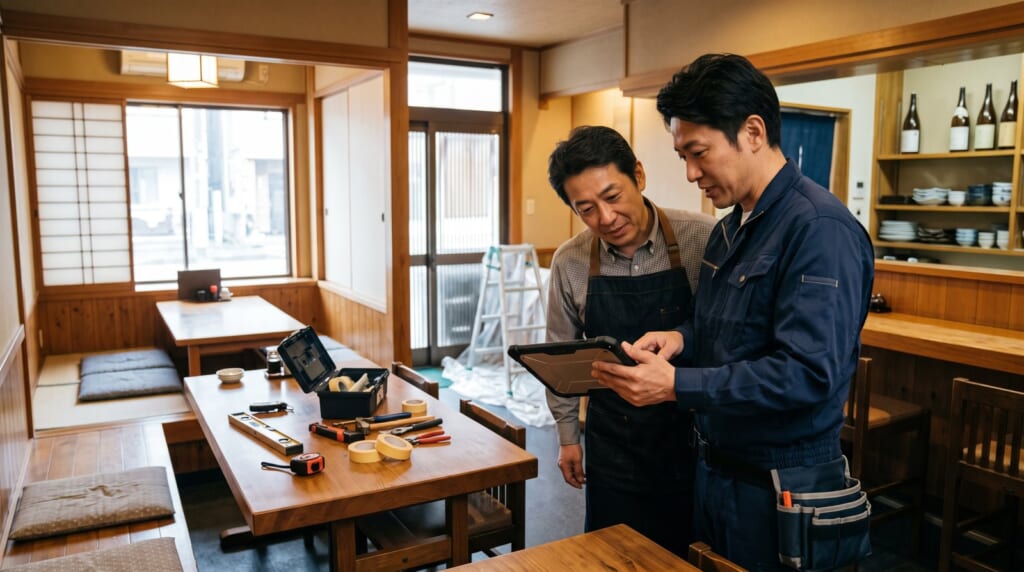
Peeling wallpaper, a door that sticks, an extra shelf, more lighting — even small restaurant repairs can be done as one-off jobs if you choose the right trade and send photos and measurements up front. Builders sometimes turn small jobs down, but how you ask makes a big difference.
Some repairs do need a licence, though — electrical, water supply and gas — and repairing a restaurant that is still trading brings its own considerations.
This article covers why small repairs get turned down and how to make them easier to take on, the licences and usual contractors for each type of repair, working around opening hours, what makes up the cost, and what to do first in an emergency — all from a practical point of view.
Why small repairs get turned down — and how to make them easier to take on
Small repairs here means fixing localised wear or faults in a restaurant’s interior or services that come up in day-to-day trading, rather than major work on the building as a whole. The main reason they get turned down is that the job is small compared with the travel and preparation involved. Travel time and call-out costs are the same however short the job, so quotes and budgets often don’t line up.
- Bundle the repairs together: rather than “just adjust the door”, group jobs the same trade can handle — adjusting the door, patching wallpaper, adding a shelf — into one request.
- Send photos and measurements first: wide and close-up shots of the problem, plus model numbers and the surroundings. With partial wallpaper or flooring repairs, the existing finish may have discoloured from grease or sunlight, so new material can show at the joins. Photos taken with the lights on help the craftsman judge whether a patch will do or a full replacement is better.
- Offer a range of dates: giving several options rather than one fixed slot makes it easier to fit into the craftsman’s schedule.
Licences and usual contractors by type of repair
Some repairs legally require a licence, so choose who to call based on the type of fault. Unlicensed electrical, water supply or gas work breaks the law and can lead to fires, leaks and other accidents.
| Type of repair | Examples | Licence / requirement | Usual contractor |
|---|---|---|---|
| Wallpaper and flooring | Replacing part of the wallpaper, repairing floor tiles | No licence needed (*1) | Interior contractor, wallpaper installer |
| Doors and shelving | Adjusting a sticking door, adding shelves, planing a counter | No licence needed | Carpenter, joiner |
| Lighting and outlets | Adding outlets, moving switches, lighting circuits | Licensed electrician | Electrical contractor |
| Plumbing | Replacing a tap or washer, extending or moving supply pipes | “Minor changes” with no pipework, such as replacing a single tap or a washer, need no licence. Supply pipe work needs a “designated water supply installer” appointed by the water utility | Plumbing contractor |
| Gas | Adding gas outlets, connecting gas appliances | City gas: the gas company or its designated contractor / LPG: a licensed LPG equipment installer | Gas company, LPG supplier |
*1 Depending on the building and how a room is used, walls and ceilings may have to be finished in non-combustible materials (interior finish restrictions under the Building Standards Act). Under the Fire Service Act, curtains, carpets, floor coverings and similar items used in restaurants must be certified flame-retardant products (source: Tokyo Fire Department, premises subject to flame-retardant rules (Japanese), checked 9 October 2026).
* The scope of “minor changes” to water supply is set by Article 13 of the Water Supply Act Enforcement Regulations (source: Ministry of Land, Infrastructure, Transport and Tourism, designated water supply installer scheme (Japanese), checked 9 October 2026).
* In multi-tenant buildings, some areas can only be worked on by the building’s nominated contractor. Check with the management company before any work. For more on where the licensing lines fall, see “DIY Plus Licensed Trades”.
Repairing a restaurant that is still trading
When you carry on trading through a repair, your customers and food hygiene come first.
- Choose the timing: have the work done before opening, during the afternoon break or on a closed day, so noise, dust and the smell of paint or adhesive don’t reach the dining area.
- Protect everything properly: protection here means covering the furniture, kitchen equipment and food around the work area with sheets and tape so dust and paint can’t get on them. In a restaurant, it matters especially for hygiene.
- Check with the public health centre and fire station: repairs that move kitchen or wet areas, or change how rooms are divided, can affect your business licence or fire safety standards. Ask both in advance whether any procedure is needed.
What makes up the cost of a small repair
Think of the cost of a small repair as the total including travel and preparation, not just the work itself. Knowing the breakdown helps you judge whether a quote is reasonable.
- Labour: the work itself. With floor or door repairs, lifting the surface can reveal damaged substrate or missing backing in the wall, adding repair work. Ask about the substrate when you first get in touch.
- Call-out: travel to the site, parking and so on. It may apply even to short jobs.
- Materials: wallpaper, timber, screws, adhesive, switch plates and the like. If you supply the materials yourself there is no charge for them, but adaptation may be charged separately.
- Disposal: removed wallpaper, old light fittings, doors and other items taken out.
- Out-of-hours surcharge: work late at night, early in the morning or on a closed day may cost extra.
Prices vary widely by area, building, extent of damage and time of year.
What to do first in an emergency (leaks, blocked drains, power cuts)
If you have a leak, an overflowing drain or a power cut, make things safe and stop the damage spreading before you look for a contractor. These are general first steps.
- Water leak: close the stopcock or main valve to cut off the water. If electrical equipment is wet, switch off that circuit at the distribution board if you can do so safely, and don’t touch the wet equipment. In a multi-tenant building there may be a nominated contractor or building insurance arrangements, so call the management company or landlord first. Otherwise, contact a designated contractor listed by your local water utility.
- Blocked or overflowing drain: stop using sinks and kitchen equipment immediately and don’t force more water down. Check the grease trap and drains for blockages, and call the management company or a drain-cleaning contractor.
- Power cut or tripped breaker: check whether neighbouring premises have lost power too. If it is just your restaurant, switch off the equipment you were using and check the distribution board. If you can’t find the cause, or suspect an earth leakage, don’t keep trying — ask an electrical contractor or your power company (in buildings with a high-voltage supply, contact the building’s chief electrical engineer or the management company).
Want to talk about a small repair?
At Tenpos Kawaguchi Interior Materials, we can introduce craftsmen to take on small restaurant repairs, and you can also ask us about repairing used furniture and fixtures you have bought. On our contact form, choose “Repairs” and describe the problem — you can attach up to three photos. Please note that we can’t take emergency repairs such as water leaks.
We can introduce independent craftsmen for every trade involved in a restaurant fit-out, anywhere in Japan, including just the trade you need, such as patching wallpaper or adjusting a door. There’s no fee to you as the client, and quotes are free. You contract with and pay the craftsman directly.
Ask about a repair → How craftsman introductions work →