
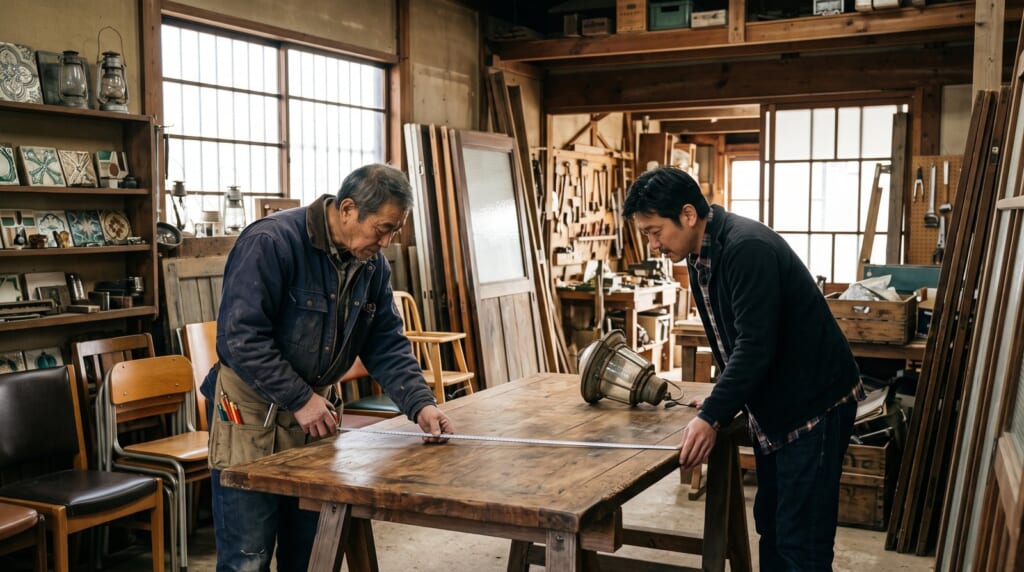
If you are using used interior materials — furniture, doors and fittings, lighting, flooring, reclaimed wood — in a restaurant, the most important thing is to check the condition and size of each item, and to judge by the total cost up to installation rather than the price tag.
A bargain can end up costing more than new if it doesn’t fit and has to be adapted, or can’t be carried in, once labour and disposal are added.
This article covers what to check item by item, the classic “cheap but expensive in the end” mistakes, how to work out the total cost, and the legal points to watch — all from a practical point of view. For where to buy, see “Where to Buy Used Interior Materials”; for choosing reclaimed wood, “Reclaimed Wood & Scaffold Boards”; and for typical prices, “Used Restaurant Interior Materials: Prices”.
Classic “cheap but expensive in the end” mistakes
The total cost is the price of the material plus delivery, carrying in, adaptation or installation, and disposal — everything up to the point it is installed. Choosing on price alone tends to lead to mistakes like these.
- It won’t go in: buy a large sofa or a slab table without measuring the entrance door, lift and corridor corners, and it may not fit into the restaurant. If it has to be lifted in from outside or taken apart, that costs extra labour.
- There isn’t enough: used materials are often one-offs or limited stock, so you may not be able to buy more of the same later. Buy floor tiles or wall materials for the exact area only, and offcuts and breakages can leave you short and buying something else.
- Adaptation and repair add up: a cheap old door or reclaimed timber can end up costing more than new once a carpenter has straightened warping, built a frame or pulled out old nails.
- Disposal costs money: materials you couldn’t use and old furniture you replaced can’t go out as household rubbish. Business waste has to be handled by a licensed waste contractor or similar (depending on the item, it is classed as industrial waste or general business waste).
What to check, item by item
Used materials wear in different places, and need different checks, depending on what they are.
| Item | Common problems | Check before you buy | Watch when installing |
|---|---|---|---|
| Chairs, tables, sofas | Wobbles, scratched legs, torn or faded seats, flattened cushions | Put weight on it on a flat floor to check for wobble / check the levelling feet aren’t broken / check the upholstery and cushions | Table height suits the seat height / size doesn’t narrow the aisles |
| Doors and sliding doors | Wrong size, warping, missing hinges, locks or other hardware | Measure height, width and thickness to the millimetre / measure the diagonals to check for warping / check the handle, lock and hinges are there | Whether it fits the existing frame or needs a new one / which way it opens |
| Light fittings | Worn cords, damaged sockets | Check the cord insulation for splits or scorching / which bulbs and base size it takes / whether it carries a PSE mark or similar | Fittings wired directly into the circuit need a licensed electrician (see below) |
| Flooring and tiles | Not enough, colour differences between production batches | Get more than you need (ask the installer how much extra) / check boxes for colour differences | Compatibility with the substrate and choice of adhesive / joint width |
| Reclaimed wood, slabs, scaffold boards | Woodworm, warping, damp, old nails or screws | Look for insect holes, rot or mould / check for remaining nails / check whether where you’ll use it falls under interior finish restrictions (see below) | Remove metal before cutting / allow for warping from damp when fixing |
* If you can’t judge the condition, send photos and measurements to the craftsman who will install it. For having materials you bought installed by a craftsman, see “Getting a Craftsman to Install Materials You Supply”.
Light fittings and licences: fittings that simply plug into a ceiling hook socket or a lighting track can be fitted without a licence. Fittings wired directly into the wall or ceiling circuit need a licensed electrician.
Working out the total cost
To keep within budget with used materials, compare the total cost up to installation, not the sale price. Think of it in five parts.
- Item price: the price of the material itself.
- Delivery: shipping from the store to the site. Large furniture and heavy items (slabs, large quantities of tiles) can cost more to ship. The amount depends on distance, size and delivery conditions.
- Carrying in: with kerbside delivery (handed over on the back of the truck), carrying items into the restaurant or up stairs may cost extra.
- Adaptation and installation: work you hire a craftsman for, such as cutting a door down, changing table legs, fitting shelves or wiring lights.
- Disposal: packaging, offcuts from adaptation, and old fixtures you remove.
Kitchens and other open-flame areas, and flame-retardant products
To guard against fire, restaurants face rules on which finishing materials and fabrics they can use. Choose reclaimed wood or fabrics on looks and price alone, and an inspection may make you replace them.
- Interior finish restrictions (Building Standards Act): interior finish restrictions are rules under the Building Standards Act requiring non-combustible finishes on walls and ceilings to stop fire spreading. Rooms with open-flame equipment such as a cooker (kitchens and the like) may be covered, so you may not be able to fix reclaimed wood or plywood straight onto the walls or ceiling. How they apply depends on the building’s construction and equipment such as sprinklers, so check before you start.
- Flame-retardant products (Fire Service Act): curtains, fabric blinds, carpets and similar items used in restaurants must be certified flame-retardant products (source: Fire and Disaster Management Agency, flame-retardant products (Japanese), checked 9 October 2026). When using second-hand curtains or rugs, check for the flame-retardant label. Furniture such as sofas is not among the items covered.
* How the rules apply depends on the building’s construction, number of floors, building rules and local ordinances. Check with your local fire station, the municipal building department and the management company before buying materials or starting work.
Checking in store versus buying online
- Seeing it in store: you can check texture, colour, comfort, warping in timber and smells first-hand. Feel how deep scratches are, and have chairs and tables put on a flat surface so you can put your weight on them. Bring a tape measure and measure not just the outside dimensions but the gap between legs and the seat height. If the store lets you load your own truck, you can avoid delivery costs.
- Buying online: you can search lots of stock by size and design without visiting. Look at close-ups of scratches and marks, and remember colours can look different on screen. Check dimensions (height, width, depth, weight) to the millimetre, and ask anything unclear — wobbles, damage on the back — before you buy. Asking whether extra photos are available is worth a try too.
Used interior materials at Tenpos
Tenpos Kawaguchi Interior Materials sells used restaurant interior materials (chairs, tables, sofas, lighting, doors and fittings, flooring, tiles, reclaimed wood, timber slabs, fixtures and more) in store and online. Everything we buy in is inspected, cleaned and repaired in our own workshop before it goes on sale, and anyone — trade or private — can buy.
We can load trucks up to 4 tonnes on site and deliver anywhere in Japan from the store (large items and some locations by arrangement). Tell us your build schedule and we’ll agree how long to hold your materials. As a rule, we don’t accept returns or exchanges, so we recommend measuring and checking condition before you buy; if there’s a problem, talk to us and we’ll look at it case by case. We can also introduce a craftsman to install what you buy (no fee to you as the client, and quotes are free).
See our used materials store → Book a visit / check stock →