
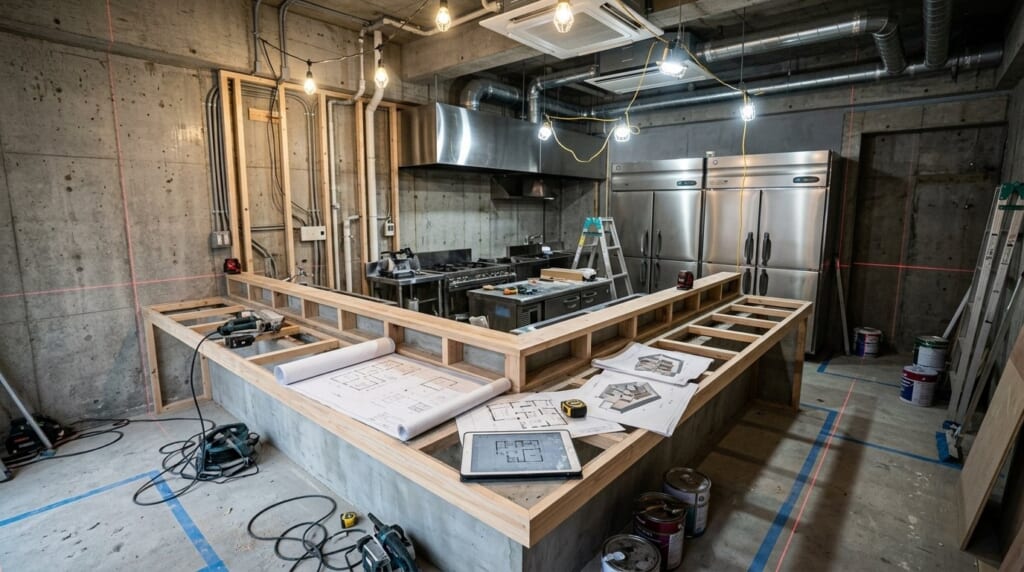
The fit-out quote lands, and it’s far above the money you have saved. You still need the deposit, the kitchen equipment and cash to run the place. Where can you cut and still open, and what must you leave alone? It’s a question we hear all the time from people getting ready to open.
The money needed to open a restaurant covers the deposit on the unit, the interior and exterior fit-out, kitchen equipment, fixtures and furnishings, and working capital for after opening. Used materials and DIY can cut the cost of dining-room furniture such as chairs, tables and lighting, and of interior finishing work that needs no licence. They can’t cut the deposit, licensed work such as electrical, gas, water and drainage, or working capital.
In this article, Tenpos Kawaguchi Interior Materials (Kawaguchi, Saitama; 1,254 m²) uses a Japan Finance Corporation survey and prices from our own online store to set out typical startup costs and their breakdown, and which costs used materials and DIY can and can’t cut.
How much does it cost to open a restaurant?
A good benchmark comes from the Japan Finance Corporation (JFC), a government-owned lender, and its annual survey of new businesses. In the FY2025 survey, the median startup cost was 6 million yen and the average was 9.75 million yen.
By range, 20.1% of businesses opened for under 2.5 million yen and 21.7% for 2.5 to 5 million yen, so more than 40% started on less than 5 million yen. The average sits above the median because a small number of large openings pull it up; the median is closer to what most owners actually spend.
Note that the survey covers all industries, including services, healthcare and welfare, not just restaurants (restaurants and accommodation made up 14.5% of new businesses). Restaurants need kitchen services and equipment, so build up your own figure from the breakdown below.
Source: JFC Research Institute, “FY2025 Survey of New Business Startups” (Japanese; published December 2025, checked 4 November 2026)
What goes into the startup budget?
A restaurant’s startup budget splits into capital costs for building the restaurant and working capital for running it after opening. The JFC’s startup guide for restaurants includes a sample business plan totalling 10 million yen.
| Type | Item | Sample amount | What it covers |
|---|---|---|---|
| Capital cost | Interior and exterior fit-out | 4,000,000 yen | Strip-out, floors, walls, ceilings, electrical, water and drainage, gas, ventilation, signage, etc. |
| Capital cost | Kitchen equipment | 1,500,000 yen | Refrigerators, ranges, sinks, ice machine, etc. |
| Capital cost | Fixtures and furnishings | 1,000,000 yen | Chairs, tables, lighting, tableware, POS register, etc. |
| Capital cost | Deposit | 1,200,000 yen | Money held by the landlord when you lease the unit |
| Working capital | Stock, advertising and other expenses | 2,300,000 yen | Stock 900,000 yen; advertising and other expenses 1,400,000 yen |
* The amounts are the JFC’s sample figures, not averages or benchmarks. The “What it covers” column is our own summary of the main items in each line.
Source: JFC, “Startup Guide Plus” for restaurants (September 2025), sample business plan (Japanese; checked 4 November 2026)
In the JFC sample, the fit-out accounts for more than half of the 7.7 million yen in capital costs. The fit-out and the fixtures and furnishings are also where there is the most room to bring costs down.
Which costs used materials and DIY can cut, and which they can’t
Used materials and DIY can cut costs that need no licence and where you can judge the quality with your own eyes. Work that the law says needs a licence, and money fixed by the lease, can’t be reduced this way.
| Item | Can used or DIY cut it? | Why, and what to watch |
|---|---|---|
| Fixtures and furnishings | Yes | Chairs, tables, lighting, doors and decor can be bought used after checking the actual piece |
| Interior finishes | Partly | Work that needs no licence, such as painting dining-room walls, putting up shelves and assembling furniture, can be done yourself. Wall and ceiling finishes may fall under the interior finish restrictions of the Building Standards Act |
| Electrical, gas, water and drainage work | No | Laws and local regulations require a licence or a designated contractor. Not DIY work |
| Kitchen floors, walls and sinks | Hard to cut | Must meet the public health centre’s facility standards, which differ by municipality |
| Deposit | No | Set by the lease. With a second-hand restaurant space, you may also pay for the outgoing tenant’s fit-out |
| Working capital | Don’t cut | Carries you through the months after opening when sales fall short of plan |
Under the Electrical Contractors Act, only a licensed electrician may do electrical work (apart from minor tasks that a ministerial ordinance treats as posing no safety risk). For the water supply, the Waterworks Act lets the local water utility designate approved contractors, so you hire a contractor designated by your local utility. Drainage work is done by contractors designated under the municipality’s sewerage regulations; city gas work by the gas company or its designated contractors; and LP gas work by a certified LP gas equipment technician.
Set electrical, gas, water and drainage work aside from the start as jobs for licensed tradespeople. Where to draw the line between what you can do yourself and what needs a licence is explained stage by stage in “How to combine DIY with licensed trades”.
Sources: Electrical Contractors Act, Article 3; Waterworks Act (e-Gov law search, Japanese; checked 4 November 2026)
What does it cost to furnish a dining room with used pieces?
You can estimate the cost of furnishing a dining room with used pieces from the prices in our online store. Of the 371 items listed on 7 October 2026 (all used), the median price was 8,800 yen including tax, and more than half (209 items) cost 10,000 yen or less.
| Item | Quantity | Median (incl. tax) | Subtotal |
|---|---|---|---|
| Chairs | 20 | 8,800 yen | 176,000 yen |
| Tables | 5 | 11,550 yen | 57,750 yen |
| Lighting | 4 | 4,400 yen | 17,600 yen |
| Total | 251,350 yen |
* A rough guide based on the median price for each category. Whether you can get enough of the same piece depends on stock. Shipping not included. Stock and prices change daily.
Source: Used Restaurant Interior Materials: Prices in October 2026 (371 Items in Our Kawaguchi Online Store)
The JFC sample allows 1 million yen for fixtures and furnishings. That figure also includes tableware and a register, so it isn’t a like-for-like comparison, but knowing that 20 chairs, 5 tables and 4 lights come to around 250,000 yen gives you a sense of scale when setting the budget.
The catch with used furniture is whether you can find 20 matching chairs. Many used pieces are one-offs, so the same model may not be available in the numbers you need. If you have a lot of seats, check stock levels first, or plan to mix different chairs.
Which costs should you not cut?
When trimming the budget, keep your working capital and a contingency fund. You may manage to open by cutting back on the fit-out and furniture, but if the money runs out after opening, you can’t keep the restaurant going.
The JFC startup guide asks owners to check that they have working capital for advertising and recruitment at opening, along with enough to cover around six months of losses. Plan your working capital on the assumption that some early months will fall short of your sales targets.
During a fit-out, extra costs can appear from problems found after work starts or from “excluded works” not in the quote. The situations where this tends to happen are covered in “Eight places restaurant fit-out costs creep up”. Put the money you save with used materials and DIY into this contingency first, so that extra costs during the works don’t drain your funds.
Start by entering your own figures into the sample table and marking each line “can used or DIY cut it?”. Once you have split the costs you can cut from those you can’t, you’ll know where to spend time hunting for cheaper materials and where to keep money in reserve.
How we can help bring your startup costs down
Tenpos Kawaguchi Interior Materials helps owners open by cutting purchase costs with used materials, doing what they can themselves, and bringing in licensed tradespeople only for the work that needs them.
- Choose used materials in person: On a single 1,254 m² floor, you can see and handle chairs, tables, lighting, doors, flooring and reclaimed timber. Everything on the shop floor has been inspected, cleaned and repaired in our own workshop.
- Hold items to suit your build schedule: We agree how long to hold items around your works schedule. Trucks up to 4 tonnes can load on site, and we deliver anywhere in Japan from the store (large items and some locations by arrangement).
- Bring in tradespeople only where needed: We introduce craftsmen only for licensed work such as electrical, gas, water and drainage (no introduction fee for clients, free quotes, and you contract and pay the craftsman directly).
- Check your layout in 3D: Create a 3D floor plan with our staff in store, free of charge (by appointment; viewed on our in-store screen, not an official drawing).
Tenpos Kawaguchi Interior Materials
3-32-24 Sakashita-cho, Kawaguchi, Saitama / Open 10:00–19:00 every day (closed over the New Year holidays)
Tel +81-48-285-2027 / Parking available (trucks up to 4 tonnes, loading on site) / Payment: cash, card or PayPay
Talk to us about your build → Book a visit (materials, 3D plans) →