
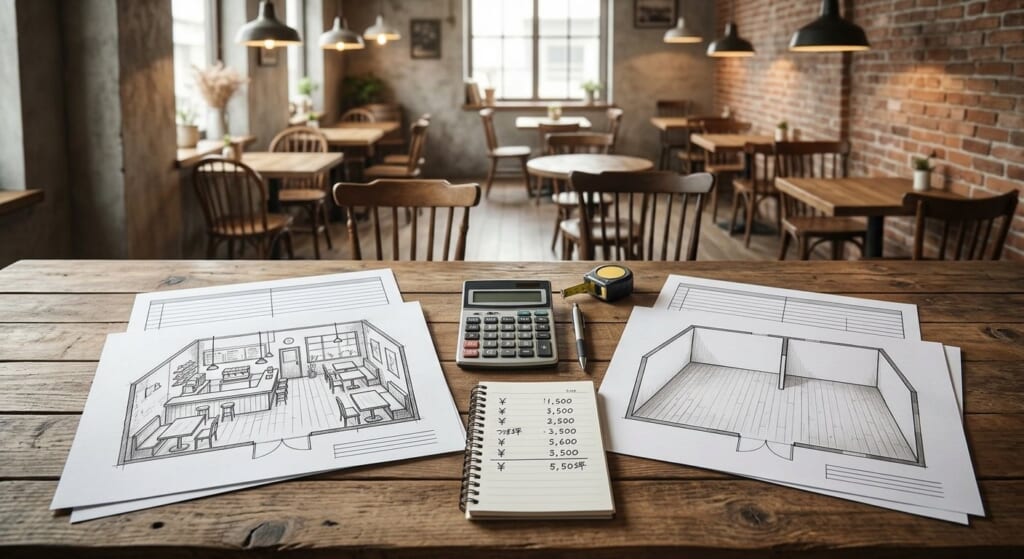
You get fit-out quotes from two contractors for the same 15-tsubo unit, and they are more than 2 million yen apart. Plugging them into the per-tsubo rates you found online doesn’t tell you which one is expensive. And if you pick the cheaper one, you worry about extra costs later. It’s a common sticking point when comparing quotes.
The fit-out cost per tsubo is the fit-out cost divided by the floor area in tsubo (1 tsubo is about 3.3 m²), giving a price per tsubo. It is a useful guide to whether a quote is high or low, but what each quote includes varies, and smaller restaurants tend to cost more per tsubo, so price per tsubo alone can’t tell you which quote is better.
In this article, Tenpos Kawaguchi Interior Materials (Kawaguchi, Saitama; 1,254 m²) uses the benchmarks published by the Tenpos Group’s restaurant startup support site and prices for our own used materials to explain how to work out the price per tsubo, how second-hand and shell space differ, what to check in a quote, and what changes when you mix in used materials.
How do you work out the fit-out cost per tsubo?
Divide the fit-out cost by the restaurant’s floor area in tsubo. For example, a 15-tsubo restaurant with a fit-out cost of 7.5 million yen works out at 500,000 yen per tsubo.
To estimate the fit-out cost from a per-tsubo benchmark, multiply the rate by the number of tsubo. While you are still looking at units, this quick multiplication gives you a sense of scale for each candidate.
How much does the price per tsubo differ between second-hand and shell space?
The price per tsubo changes a great deal depending on whether the unit is a second-hand restaurant space or a shell. In a shell unit, floors, walls, ceilings and services are all built from scratch, whereas a second-hand restaurant space keeps the previous restaurant’s fit-out and services and only the parts that need it are redone.
| Unit condition | Benchmark per tsubo | For 15 tsubo |
|---|---|---|
| Shell (about 15 tsubo) | 300,000–500,000 yen | 4.5–7.5 million yen |
| Shell (restaurant) | 450,000–600,000 yen | 6.75–9 million yen |
| Second-hand space (refit) | 200,000–500,000 yen | 3–7.5 million yen |
* Benchmarks are those published by the Tenpos Group’s restaurant startup support site (no publication date given). The shell figure of 300,000–500,000 yen is the going rate for a unit of about 15 tsubo; 450,000–600,000 yen is the guide for restaurants, which need kitchen services. The “For 15 tsubo” column is our own calculation, not a quote. Prices move with materials and labour costs, so confirm actual amounts with a quote.
Source: Tenpos Restaurant Startup Map, “Izakaya interiors” (Japanese; checked 4 November 2026)
The Tenpos Group’s startup support site also puts design and design supervision fees at around 5–15% of the construction cost, and exterior work such as facade and signage at about 1–2 million yen. Some quotes leave these out of the per-tsubo figure, so budgeting from the table alone tends to come up short.
A second-hand restaurant space doesn’t always mean a low price per tsubo. If the previous business was a different type of restaurant, you may need extra services work because the electrical capacity is too low or the gas supply too weak. The checklist in “Second-hand restaurant space or shell unit?” helps you decide between the two.
Why can’t you compare quotes on price per tsubo alone?
Price per tsubo alone can’t settle a comparison because what it includes, and the conditions that drive it, differ from quote to quote. There are three reasons, and each is checked in a different way.
What the price per tsubo covers
There is no rule about what goes into the price per tsubo. A quote that includes design fees, exterior and signage, kitchen equipment, and strip-out and waste disposal will have a very different price per tsubo from one that leaves them out, even for the same restaurant. With a cheap quote, first check whether work included in the other quotes has been marked as “excluded”.
Restaurant size and price per tsubo
The Tenpos Group’s startup support site notes that the price per tsubo is not fixed and falls as the project gets bigger. Kitchen water, drainage, gas and ventilation, toilets and so on are needed whatever the size, so the smaller the restaurant, the heavier the cost per tsubo. Judging a small restaurant’s quote as “expensive” against per-tsubo rates for larger spaces is premature.
Unit conditions and the work required
Even at the same size, the work needed and its cost change with the electrical and gas capacity, the route for the exhaust duct and the building’s works categories (such as B works, carried out by a contractor the landlord designates). The situations where unit conditions tend to add cost are covered in “Eight places restaurant fit-out costs creep up”.
What should you check in the per-tsubo price of a quote?
When comparing quotes, look past the total and set out the following items for each quote in one table, marking whether each is included. Fill any gaps with the amount from another quote before you compare, and you’ll see where the difference comes from.
| Item to check | Why it matters |
|---|---|
| Design and design supervision fees | Said to be around 5–15% of the construction cost; may be included in the construction cost when the contractor also does the design |
| Exterior and signage | Work on the outside of the restaurant may be quoted separately from the interior. Outdoor signs may need a permit from the municipality |
| Kitchen equipment and installation | The equipment itself may be bought separately, with only installation and connection in the quote |
| Strip-out and waste disposal | The cost of removing the previous restaurant’s fit-out in a second-hand space. Varies with the amount to be disposed of |
| Asbestos pre-survey | By law, a survey for asbestos is required before demolition or renovation work |
| Electrical, gas, water and drainage upgrades | Needed when the unit’s capacity falls short, and often marked “excluded” at the quote stage |
* The asbestos pre-survey is required under the Air Pollution Control Act. For demolition of buildings with a floor area of 80 m² or more, or alteration and repair work with a contract value of 1 million yen or more, the survey results must also be reported.
Source: Shiga Prefecture, “Asbestos measures” (explanation of the amended Air Pollution Control Act) (Japanese; checked 4 November 2026)
What changes in the price per tsubo when you mix in used materials?
If you source used materials yourself and have a craftsman install them (owner-supplied materials), the material cost for those items drops out of the quote. The installation labour remains, though, and some materials may need extra work to fit, which adds cost.
The easiest items to supply yourself are finishes that can be chosen piece by piece and are relatively simple to install. Prices in our online store (371 items, all used, as of 7 October 2026) were as follows.
| Category | Items | Median price (incl. tax) | Price range (incl. tax) |
|---|---|---|---|
| Doors and partitions | 34 | 16,500 yen | 2,475–132,000 yen |
| Lighting | 14 | 4,400 yen | 2,475–9,900 yen |
| Counters | 3 | 13,200 yen | 11,000–16,500 yen |
| Building materials, tiles and slab tables | 16 | 16,225 yen | 4,455–78,100 yen |
* Stock and prices change daily. The store also carries materials not listed online.
Source: Used Restaurant Interior Materials: Prices in October 2026 (371 Items in Our Kawaguchi Online Store)
Some craftsmen turn down owner-supplied materials. Before the job, you need to agree who is responsible if the materials you supplied are faulty and what happens if they don’t fit. Why requests get turned down and how to ask are covered in “Getting a craftsman to install materials you supply”.
Start by running the quotes you have against the “Item to check” table and marking what is and isn’t included. Once the items line up, you can separate differences in the scope of work from differences in unit prices.
How we can help bring fit-out costs down
Tenpos Kawaguchi Interior Materials helps owners open by cutting purchase costs with used materials, doing what they can themselves, and bringing in licensed tradespeople only for the work that needs them.
- Split the quote into materials and work: Choose doors, lighting, counters and other materials you can supply yourself, seeing the actual pieces on our 1,254 m² floor. Everything on the shop floor has been inspected, cleaned and repaired in our own workshop.
- Hold items to suit your build schedule: We agree how long to hold items around your works schedule. Trucks up to 4 tonnes can load on site, and we deliver anywhere in Japan from the store (large items and some locations by arrangement).
- Bring in tradespeople only where needed: We introduce craftsmen only for licensed work such as electrical, gas, water and drainage (no introduction fee for clients, free quotes, and you contract and pay the craftsman directly).
- Settle the layout before work starts: Create a 3D floor plan with our staff in store, free of charge (by appointment; viewed on our in-store screen, not an official drawing).
Tenpos Kawaguchi Interior Materials
3-32-24 Sakashita-cho, Kawaguchi, Saitama / Open 10:00–19:00 every day (closed over the New Year holidays)
Tel +81-48-285-2027 / Parking available (trucks up to 4 tonnes, loading on site) / Payment: cash, card or PayPay
Talk to us about your build → Book a visit (materials, 3D plans) →