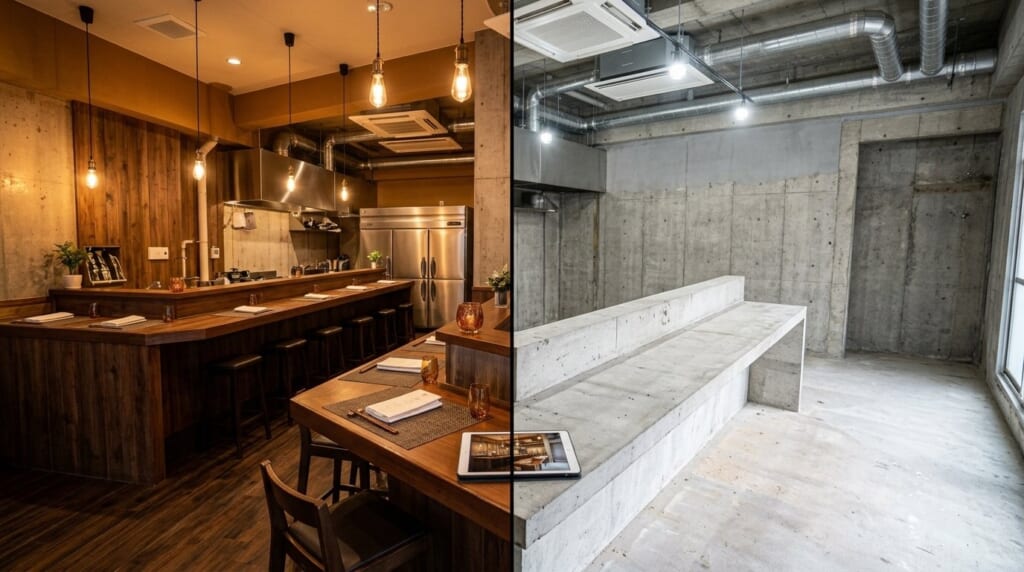
In the area you like, there is a second-hand restaurant space and a shell unit both on the market. The second-hand space comes with a fee for the previous tenant’s fit-out, but the kitchen and counter are still there and it looks as if you could open quickly. The shell lets you build from scratch, but you have no idea what the fit-out will cost. It’s a common dilemma when looking for a unit.
A second-hand restaurant space is a unit let with the previous tenant’s fit-out and equipment still in place. A shell unit is let with the fit-out and equipment removed. Which works out better depends on the previous business, the kitchen layout, and the capacity and condition of the services, so there is no single answer. Compare a second-hand space on “the fee for the existing fit-out plus the refit”, and a shell on “the total fit-out cost”.
In this article, Tenpos Kawaguchi Interior Materials (Kawaguchi, Saitama; 1,254 m²) uses information from the Japan Finance Corporation and the Tenpos Group’s restaurant startup support site to set out what to check when choosing between a second-hand space and a shell.
Which is cheaper: second-hand space or shell?
A second-hand restaurant space makes it easier to keep fit-out costs and lead times down, to the extent that you can use the fit-out and equipment already there. The Tenpos Group’s startup support site also says that where you can use the existing interior more or less as it is, you can open faster and for less.
That saving, however, only holds if the equipment left behind works for your restaurant. The Tenpos Group’s startup support site also notes that if the previous business was a different type of restaurant, problems such as too little electrical capacity or a weak gas supply can mean extra work. A second-hand space also comes with a fee for the existing fit-out, so comparing on construction cost alone leads to the wrong call.
How the situations that add cost differ between second-hand and shell space is compared in “Eight places restaurant fit-out costs creep up”.
Source: Tenpos Restaurant Startup Map, “Izakaya interiors” (Japanese; checked 4 November 2026)
Which suits your restaurant? A checklist
You can get a sense of which suits you by seeing which column most of these six items fall into. If even one falls under “Shell suits you”, get a quote for the work to fix it and add that to the second-hand total before comparing.
| What to check | Second-hand space suits you | Shell suits you |
|---|---|---|
| Previous business | Same or similar (e.g. an izakaya taking over an izakaya) | Different (e.g. a ramen shop taking over a café) |
| Kitchen position and size | Can be used as laid out | You want to move or resize it substantially |
| Electrical, gas, water, drainage and exhaust capacity | Enough for your equipment | Not enough; upgrades needed |
| Condition of leftover equipment | Tested with a specialist and usable | Old, not working, or ownership unclear |
| Time to opening | Short; you want to open soon | You can allow time for the works |
| Look and feel | You can work with the current interior | You want to change it substantially (strip-out costs apply) |
Of these, the previous business and the services capacity weigh most heavily on a second-hand space. A different type of business means different kitchen equipment and different electrical and gas needs, so more of the existing equipment is likely to be unusable.
What should you check before paying for the previous tenant’s fit-out?
The fee for the previous tenant’s fit-out is the price a new tenant pays the outgoing tenant to take over the interior and equipment left in a second-hand restaurant space. The Tenpos Group’s startup support site notes that this fee is set by the unit’s location and ability to draw customers, not by what the fit-out cost or how long it has been used.
Because the fee doesn’t reflect the value of the equipment, you need to check for yourself what you are paying for before you pay. The Japan Finance Corporation’s startup guide likewise asks owners taking a second-hand space to check the breakdown and fairness of the price for the fit-out and equipment being handed over, and to find out why the previous owner closed.
- List of items handed over: Ask for every item included, such as kitchen equipment, air conditioning, lighting, doors, chairs and tables, to be listed one by one.
- Ownership: Check whether any of the equipment belongs to a leasing company. Leased items don’t belong to the outgoing tenant, so paying the fee won’t make them yours.
- Landlord’s consent: Check that the landlord agrees to letting the unit with the existing fit-out, and whether there is a condition to return it to a shell when you leave.
- Why the previous restaurant closed: If the reason was the location, opening a similar restaurant in the same spot could run into the same problem.
Sources: Japan Finance Corporation, “Startup Guide Plus” for restaurants (September 2025); Tenpos Restaurant Startup Map, “Izakaya interiors” (Japanese; checked 4 November 2026)
How do you check the condition of leftover equipment?
You can’t tell how many more years leftover equipment will last just by looking. It may look clean outside while internal parts are worn, or it may have stopped working after standing idle for a long time.
- Check the year of manufacture: Look at the rating plate (the label showing the maker, model and year of manufacture) on air conditioners, refrigerators, water heaters and so on to see when each was made.
- Run it: Before signing, have a specialist present while the power and gas are turned on and the equipment is run.
- Look at service and repair records: If the outgoing tenant has inspection or repair records, ask to see them.
- Agree who pays for faults: Put in the contract who will pay for repairs if a fault is found after handover.
Older equipment may not fail straight away, but may need replacing soon after you open. Factor in the replacement cost when deciding whether that equipment is worth paying for.
When you can’t decide, what should you compare side by side?
If you can’t decide, set out the money each option needs before opening under the same headings. A second-hand space can look cheaper on construction, but once you add the fee for the existing fit-out and any upgrades, the gap with a shell may narrow.
| What to compare | Second-hand space | Shell |
|---|---|---|
| Fee for the existing fit-out | Yes | No |
| Strip-out and removal | Removing fit-out you won’t use | Generally none |
| Fit-out work | Only the parts you refit | Floors, walls, ceilings and kitchen in full |
| Services upgrades | Needed if capacity falls short | Planned as part of the fit-out |
| Expected equipment replacement | Allow for older equipment | Less, as it is all new |
| Rent before opening | Tends to be lower, as works are shorter | Tends to be higher, as works take longer |
When comparing fit-out quotes, don’t rely on price per tsubo alone; first make sure the quotes cover the same scope of work. Per-tsubo benchmarks and how to read a quote are explained in “What does a restaurant fit-out cost per tsubo?”.
Start by running the units you are considering through the checklist. Get quotes for the work needed on any item that falls under “Shell suits you”, and you can compare the second-hand space and the shell on the same basis.
How we can help, whichever you choose
Tenpos Kawaguchi Interior Materials helps owners open by cutting purchase costs with used materials, doing what they can themselves, and bringing in licensed tradespeople only for the work that needs them. Whether you take a second-hand space or a shell, used materials can bring down the cost of interior finishes and dining-room furniture.
- Fill the gaps in a second-hand space: Choose chairs, tables, lighting, doors and other pieces to complement what’s already there, seeing the actual items on our 1,254 m² floor. Everything on the shop floor has been inspected, cleaned and repaired in our own workshop.
- Sell what you won’t use: Doors, furniture and lighting left in a second-hand space that you won’t use can be offered to us for buyback. Before selling, check that the fit-out handover agreement has made them yours.
- Build a shell from scratch: We hold the materials you choose to suit your works schedule. Trucks up to 4 tonnes can load on site, and we deliver anywhere in Japan from the store (large items and some locations by arrangement).
- Bring in tradespeople only where needed: We introduce craftsmen only for licensed work such as electrical, gas, water and drainage (no introduction fee for clients, free quotes, and you contract and pay the craftsman directly).
Tenpos Kawaguchi Interior Materials
3-32-24 Sakashita-cho, Kawaguchi, Saitama / Open 10:00–19:00 every day (closed over the New Year holidays)
Tel +81-48-285-2027 / Parking available (trucks up to 4 tonnes, loading on site) / Payment: cash, card or PayPay
Talk to us about your build → Book a visit (materials, 3D plans) → Ask about buyback →
FAQ (second-hand space or shell)
If I take over a second-hand restaurant space, can I take over the previous restaurant’s business licence?
In a second-hand space, can I remove equipment I don’t want to use?
Does a shell unit cost money when I move out?
Source for business licence succession: Bunkyo City, “Business transfer of food business licences and notifications” (Japanese; checked 4 November 2026)