
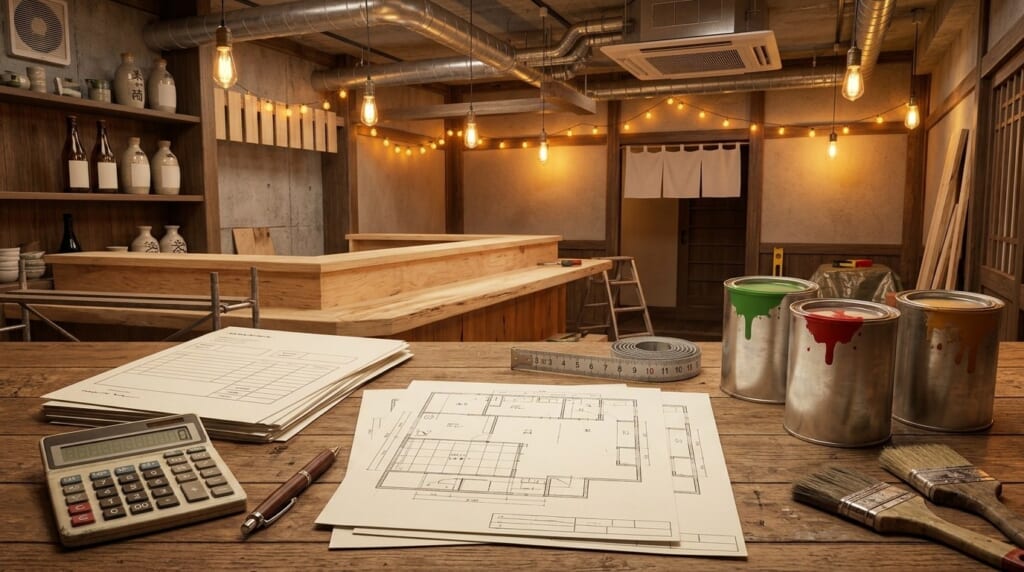
You’ve found a unit and want to start the fit-out. But you don’t know when, where, or with what you apply for the health centre’s business permit. If you’re told after the work is done that “we can’t approve this layout”, you can afford neither the cost of redoing it nor a late opening. It’s a common question from people preparing to open a restaurant.
In Japan, a restaurant business permit is a permit under the Food Sanitation Act that you must obtain from the local public health centre before opening a place that serves food or drinks to customers. You review your plans with the health centre before construction, apply with the documents and fee before you open, and the permit is issued once the finished restaurant passes an on-site inspection. In Kawaguchi City, you apply at least two weeks before opening, and the fee for a new restaurant permit is 17,600 yen.
In this article, Tenpos Kawaguchi Interior Materials (Kawaguchi, Saitama; 1,254 m²) uses the guidance of Kawaguchi City’s public health centre, where our store is located, and the Food Sanitation Act to set out the steps from the first consultation to the permit, the documents you need, and the procedures after the permit is issued.
Which restaurants need a business permit?
A restaurant business permit is needed by any shop that prepares food or drinks and serves them to customers. Under the current permit categories, coffee shops are also covered by the restaurant business permit: Appended Table 19 of the Ordinance for Enforcement of the Food Sanitation Act treats coffee shops as a simplified form of restaurant business.
A permit is issued for a combination of the operator (the person or company running the restaurant) and the premises. For this reason, Kawaguchi City’s health centre says that in cases like the following, the existing permit can’t be used and a new application is needed:
- The operator changes: a restaurant opened by an individual becomes a company, or the business is handed to another person or company
- The restaurant moves or the building is rebuilt
At the same time, the same health centre’s guidance describes a notification of succession for taking over a business by transfer, inheritance or a company merger. Which procedure applies when the operator changes should be checked with the health centre before you sign anything.
The facility standards used to decide on a permit are set by each prefecture in its own ordinance, with reference to the standards in a Ministry of Health, Labour and Welfare ordinance (Food Sanitation Act, Article 54). The permit is granted by the prefectural governor, or by the mayor in a city that runs its own public health centre, such as Kawaguchi (Articles 55 and 76). That is why the guidance on the same equipment can differ depending on where the restaurant is.
Sources: Food Sanitation Act, Articles 54, 55 and 76, Ordinance for Enforcement of the Food Sanitation Act, Appended Table 19 (e-Gov, Japanese), Kawaguchi City, “Changes to a business permit”, Kawaguchi City, “Succeeding to a permit holder’s status by inheritance, merger, split or business transfer” (Japanese; all checked 9 November 2026)
How does it go from consultation to permit?
Kawaguchi City’s health centre explains the permit process in the six steps below. The order is similar elsewhere, but deadlines and booking methods vary between health centres, so check the guidance of the health centre where your restaurant is.
| Step | When | What the owner does |
|---|---|---|
| 1. Plan review | Before construction starts | Bring the floor plan of the premises and consult at the health centre counter |
| 2. Permit application | At least 2 weeks before opening | Apply at the health centre counter with the required documents and fee |
| 3. Booking the inspection | Once the completion date is set | Book by phone with the health centre (you can also book when you apply) |
| 4. On-site inspection | After the premises are finished | A food sanitation inspector visits and checks that the premises match the application and meet the standards |
| 5. Permit issued | If the standards are met | The health centre tells you when the permit will be issued |
| 6. Opening | After the permit is issued | Keep the premises up to standard and follow the hygiene management standards |
* If the table is cut off, scroll sideways to see it all.
Source: Kawaguchi City, “Business permit application process” (Japanese; checked 9 November 2026)
Of the six steps, the one owners most often misjudge in their schedule is the on-site inspection. It takes place only after the premises are finished, and if they don’t meet the standards, no permit is issued until the problems are fixed. Leave time between the last day of construction and your opening day for the inspection and for any fixes it calls for.
A six-month schedule worked back from opening day is set out in “How do you get from lease to opening day?”.
Which documents do you need to apply?
These are the documents for a new restaurant permit application in Kawaguchi City. Some are required from everyone, and some only if a condition applies.
| Document | Who submits it | Notes |
|---|---|---|
| Permit application form | Everyone | Two copies if you want to keep one. The form can be downloaded from Kawaguchi City’s website |
| Floor plan and location map | Everyone | The floor plan should show the whole premises and the kitchen equipment in detail. The location map should show the premises with the main roads and buildings around it |
| Proof of the food hygiene manager’s qualification | Everyone | The original or a copy |
| Proof of company registration | Companies | The original or a copy of the certificate of registered matters, or something showing the corporate number and representative |
| Stool test results | If stool tests are done | The latest results |
| Water quality test results | If you use water other than tap water (such as well water) | The latest results |
| Late-night noise guidance report | If you install karaoke or other sound equipment | — |
| Letter Pack Plus envelope | If you want the permit sent by post | Write the address in advance. Depending on the inspector’s findings, it may not be possible to post it |
| Application fee | Everyone | Cash. 17,600 yen for a new restaurant permit |
* Based on Kawaguchi City health centre guidance (checked 9 November 2026). Documents and fees differ between local governments.
Sources: Kawaguchi City, “Documents for a new business permit application”, Kawaguchi City, “Permit categories and application fees” (Japanese)
The documents that take longest to prepare are the floor plan and the food hygiene manager’s qualification. The floor plan may need changes after the plan review, and if you take a course to become a food hygiene manager, you have to fit in with the course dates. Start on both when you secure the unit, not just before you apply. Who can be a food hygiene manager, and which procedures owners can handle themselves, are covered in “What can you do yourself when opening a restaurant?”.
Why review the plans before construction?
You review the plans before construction because the health centre’s final check that the premises meet the standards is the on-site inspection after the work is finished. If equipment that doesn’t meet the standards is found after construction, the walls, floor or plumbing have to be redone, and the cost and time of that work fall on the owner. At the drawing stage, all it takes is redrawing a few lines.
The floor plan you bring to the review should show at least the following:
- How the kitchen, seating area, toilet and changing space are divided, and where the entrances are
- Where the sinks and hand-washing facilities are, how many there are, and their sizes
- The layout and sizes of kitchen equipment such as refrigerators, burners and work tables
- The finishing materials for the kitchen floor, walls and ceiling
- The partition from any rooms in the same building that don’t handle food, such as living quarters
If you use second-hand equipment or materials, the plan shows the same things as it would for new ones. The facility standards cover the structure, size, number and position of equipment, and don’t distinguish between new and used. However, equipment that touches food directly must be made of water-resistant materials, be easy to clean, and be able to be disinfected with hot water or disinfectant, so check second-hand items for damage or rust that would make them hard to clean before you buy. After the plan review, you may not find a second-hand item of exactly the same size, so decide on the items first, measure them, and draw the plan to those measurements. That way, the result of the review and the actual work are less likely to drift apart.
If you change the position or size of equipment after the plan review, consult again with the revised plan. How consulting the health centre and fire department in advance helps you avoid last-minute redos is also covered in our article on pre-consultation with the health centre and fire department.
What the facility standards checked at the plan review say about sinks, hand basins, floors and walls, and ventilation is explained item by item in “What are the health centre’s facility standards for restaurants in Japan?”.
To start, mark the positions of the sinks, hand-washing facilities, kitchen equipment and toilet on your measurement notes for the unit, and book a plan review with the local health centre. Once the date is set, you can work back from it to see when you need to decide on materials and equipment.
What do you need to do after the permit is issued?
Even after you have a permit, you need to file procedures with the health centre whenever something about the restaurant changes. Kawaguchi City’s health centre divides them as below. For every change notification, bring your current business permit.
| When | Procedure | Documents besides the permit |
|---|---|---|
| You change the shop name, your home address or surname | Change notification | None |
| The food hygiene manager changes | Change notification | Proof of the new manager’s qualification |
| You change the layout, floor area or equipment positions | Change notification (moving or rebuilding may need a new application) | Floor plan of the premises |
| You turn a sole proprietorship into a company, or hand the restaurant to someone else | New permit application (a business transfer may instead need a notification of succession) | Consult the health centre in advance |
| The permit is close to expiring | Renewal application (accepted from about 3 months before expiry; the renewal fee for a restaurant is 14,000 yen) | Application form, floor plan, the original current permit, a certificate from the practical training course (taken within the past 5 years), and others |
Sources: Kawaguchi City, “Changes to a business permit”, Kawaguchi City, “Renewing a business permit”, Kawaguchi City, “Permit categories and application fees” (Japanese; all checked 9 November 2026)
On how long a permit lasts, the Food Sanitation Act says a permit may be given a validity period of no less than five years, and the local government that grants it sets the actual period. Once the period runs out, you can’t operate until you get a new permit, so check the expiry date on your permit and note when to renew as soon as you open. A renewal also involves another on-site inspection.
Once you are open, Article 51 of the Food Sanitation Act also requires operators, separately from the permit, to set and follow a hygiene management plan. Small operators may take an approach suited to the food they handle, so ask the health centre how to draw up the plan at the plan review or when you apply.
How we can help before you get your permit
Tenpos Kawaguchi Interior Materials helps owners open by cutting purchase costs with used materials, doing what they can themselves, and bringing in licensed tradespeople only for the work that needs them. The owner applies for the permit at the health centre in person, but we can help you prepare before the plan review.
- Choose your materials first and measure them: On our 1,254 m² sales floor, you can see the furniture, fittings and fixtures you want to put on your plan. Product names in our online store include width, depth and height, so you can use them to estimate sizes before you draw the plan.
- Hold the materials you choose: We can hold the materials you choose while you wait for the plan review (how long can be discussed to fit your construction schedule).
- Check the layout in a 3D plan: You can make a 3D plan free of charge in store with our staff (by appointment; it is shown on the in-store screen, and no data or printouts are provided. It is not an official drawing for health centre applications).
- Bring in tradespeople only where a licence is needed: We introduce tradespeople only for work that needs a licence, such as plumbing, gas and electrics (no introduction fee for you, free quotes, and you contract and pay the tradesperson directly).
Tenpos Kawaguchi Interior Materials
3-32-24 Sakashita-cho, Kawaguchi, Saitama / Open 10:00–19:00 every day (closed over the New Year holidays)
Tel +81-48-285-2027 / Parking available (trucks up to 4 tonnes, loading on site) / Payment: cash, card or PayPay
Talk to us about your build → Book a visit (materials, 3D plans) →