
You go to see a second-hand restaurant space and find it used to be a café. You want to open a ramen shop; you like the feel of the interior, but you don’t know whether it can be used as it is. When the type of restaurant changes, what in the fit-out has to change? It’s a question we often hear from people looking for a unit.
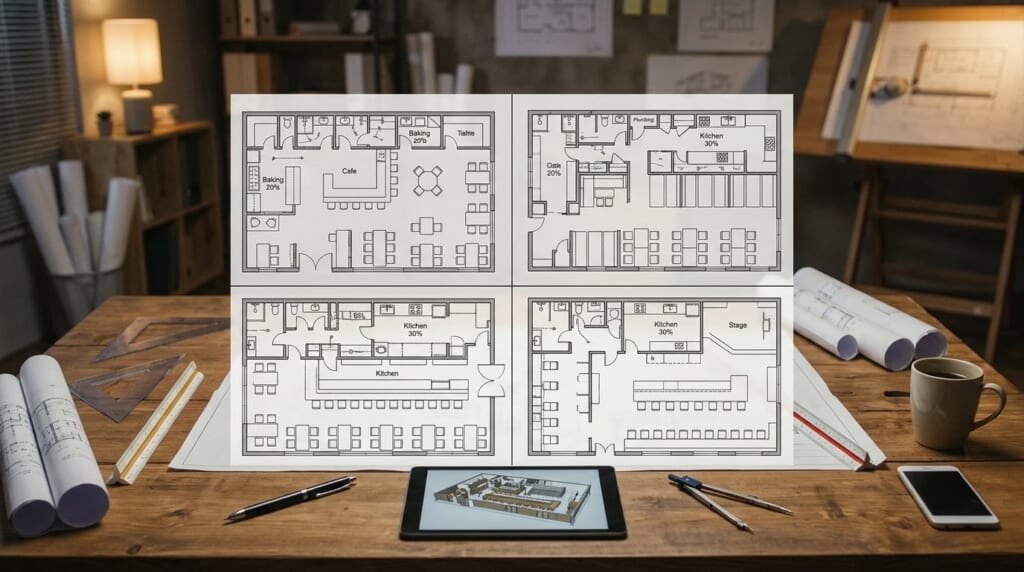
The key fit-out points by restaurant type come down to how you settle five things (kitchen, floor, ventilation, seating and legal conditions) to suit the way that type cooks and trades. As a guide, the kitchen takes 20% of the space in a café or bar and 30% in an izakaya or ramen shop, and the more smoke and grease a type produces, the more its exhaust system costs. Bars and izakaya open after midnight face conditions on room size and lighting under the Entertainment Business Act regulations.
In this article, Tenpos Kawaguchi Interior Materials (Kawaguchi, Saitama; 1,254 m²) uses the Tenpos Group’s restaurant startup support site and the regulations under the Food Sanitation Act and the Entertainment Business Act to set out the key fit-out points for cafés, izakaya, ramen shops and bars.
What differs in the fit-out from one type to another?
The fit-out differs by type because the cooking and the way customers spend their time differ. Types with a lot of simmering and frying need kitchen space and exhaust; types where customers stay long put their fit-out budget into comfortable seating; and fast-turnover types put it into speed of service.
| Type | Kitchen share (guide) | Floor and ventilation | Seating |
|---|---|---|---|
| Café | 20% | With little cooking over a flame, the load on kitchen exhaust is relatively light | Mainly tables, spaced to suit how long customers stay |
| Izakaya | 30% | Needs exhaust that keeps smoke and grease from grilling and frying out of the dining room | A mix of counter seats and tables for two or four |
| Ramen shop | 30% (often 50% in counter-only shops of 15 tsubo or less) | Draining noodles keeps the floor wet and oil and soy sauce splash, so choose the floor finish carefully. Needs exhaust for steam and grease from the broth | Mainly counter seats; a larger kitchen to put speed of service first |
| Bar | 20% | With little cooking over a flame, the load on kitchen exhaust is relatively light | Mainly counter seats; late-night trading puts legal conditions on the seating area |
* Kitchen share includes toilets, changing rooms and back-of-house space, and is the guide given by the Tenpos Group’s startup support site. The space needed varies with the menu and cooking methods, even within the same type. 1 tsubo is about 3.3 m².
Sources: Tenpos Restaurant Startup Map, “Ramen shop interiors” (dining-to-kitchen ratio); “Izakaya interiors”; “Café interiors” (Japanese; checked 4 November 2026)
How to work out seat numbers from the kitchen share, and seat guides for 10–15 tsubo restaurants, are covered in “How to lay out a small restaurant”.
How do you choose kitchen floors and walls for each type?
Whatever the type, kitchen floors and walls must meet the public health centre’s facility standards. The Enforcement Regulations of the Food Sanitation Act require floors, internal walls and ceilings to be made of materials and built in a way that is easy to clean, wash and disinfect. Where floors and walls are cleaned with water, floors must be impermeable and drain well, and internal walls must have an impermeable dado up to the height where they are easily soiled.
On top of that, how tough the floor needs to be depends on the type. The Tenpos Group’s startup support site notes that a ramen shop floor stays wet from draining noodles and gets slippery from splashed oil, soy sauce and vinegar, and that a urethane-based coated floor, which is antibacterial and impact-resistant, is used in many ramen and udon shops.
Because kitchen floors involve water and drainage work, it’s safer to treat them as a job for craftsmen rather than DIY. Dining-room floors don’t get as much water and grease as the kitchen, so there’s more freedom to choose finishes that suit the look.
Sources: Enforcement Regulations of the Food Sanitation Act, Appended Table 19 (e-Gov law search); Tenpos Restaurant Startup Map, “Ramen shop interiors” (Japanese; checked 4 November 2026)
How do ventilation and exhaust change by type?
The size of ventilation and exhaust needed depends on how much smoke, grease and steam the cooking produces. Izakaya with a lot of grilling and frying, and ramen shops that simmer broth for hours, tend to spend more on kitchen exhaust.
An open kitchen visible from the dining room needs extra care. The Tenpos Group’s startup support site notes that an open kitchen involves equipment costs to stop vaporised grease and smoke drifting into the dining room.
When changing type in a second-hand space, the previous restaurant’s exhaust may not be enough for your cooking. If you are opening an izakaya or ramen shop in a former café, check the exhaust duct size, route and outside outlet with a contractor before signing.
What fit-out conditions apply to a bar trading late at night?
A bar or izakaya trading late at night (from midnight to 6 a.m.) must meet conditions on the structure and equipment of the premises set by the Entertainment Business Act regulations. Discovering a mismatch after the fit-out is decided means rebuilding, so check at the design stage.
- Room size: If there are two or more seating rooms, each must be at least 9.5 m² (this doesn’t apply if there is only one).
- Sightlines: No fixtures inside a seating room that block the view.
- Lighting: Structure or equipment that keeps light levels in the premises from falling to 20 lux or below.
- Doors: No locks on seating-room doors (except doors leading directly outside the premises).
A restaurant mainly serving alcohol late at night may also need to file a notice through the police. Bars wanting dim lighting for atmosphere should check, when choosing fittings, that the layout and brightness of the lighting can meet the light-level condition.
Source: Enforcement Regulations of the Act on Control and Improvement of Amusement Business, Article 99 (e-Gov law search, Japanese; checked 4 November 2026)
How do you choose used materials to suit each type?
Choose used materials by whether they can stand up to how each type uses them. A piece that looks right but doesn’t suit the way it will be used wears out quickly and costs more to replace.
- Café: Customers sit for a long time, so check chair comfort and seat wear on the actual piece. Also check how table height and seat height work together.
- Izakaya: Grease and water get everywhere, so check that table tops have a finish that stands up to wiping. Doors and screens can be used to create private or semi-private areas.
- Ramen shop: Check that the counter top can take hot bowls and moisture. For fast turnover, stools that are easy to get on and off suit best.
- Bar: The counter and lighting set the impression. Check that lighting is bright enough to meet the late-night light-level condition.
In our online store (371 items, all used, as of 7 October 2026), chairs, stools and benches numbered 97, tied with decor and interior accessories as the largest category, with a median price of 8,800 yen including tax. Price ranges by category are published in “Used Restaurant Interior Materials: Prices”.
Start by comparing the “Floor and ventilation” and “Seating” columns for your type with the current state of the units you are considering. Any column that doesn’t match is where the fit-out needs work, and what to check in the quote.
How we can help, whatever your type
Tenpos Kawaguchi Interior Materials helps owners open by cutting purchase costs with used materials, doing what they can themselves, and bringing in licensed tradespeople only for the work that needs them.
- Choose materials that suit your type in person: On a single 1,254 m² floor, you can sit on and handle chairs, tables, counters, lighting and doors. Everything on the shop floor has been inspected, cleaned and repaired in our own workshop.
- Check your kitchen share in 3D: Create a 3D floor plan with our staff in store, free of charge (by appointment; viewed on our in-store screen, not an official drawing).
- Leave kitchen floors and exhaust to craftsmen: We introduce craftsmen only for licensed work such as electrical, gas, water and drainage (no introduction fee for clients, free quotes, and you contract and pay the craftsman directly).
- Hold items to suit your build schedule: We agree how long to hold items around your works schedule. Trucks up to 4 tonnes can load on site, and we deliver anywhere in Japan from the store (large items and some locations by arrangement).
Tenpos Kawaguchi Interior Materials
3-32-24 Sakashita-cho, Kawaguchi, Saitama / Open 10:00–19:00 every day (closed over the New Year holidays)
Tel +81-48-285-2027 / Parking available (trucks up to 4 tonnes, loading on site) / Payment: cash, card or PayPay
Book a visit (materials, 3D plans) → Talk to us about your build →