
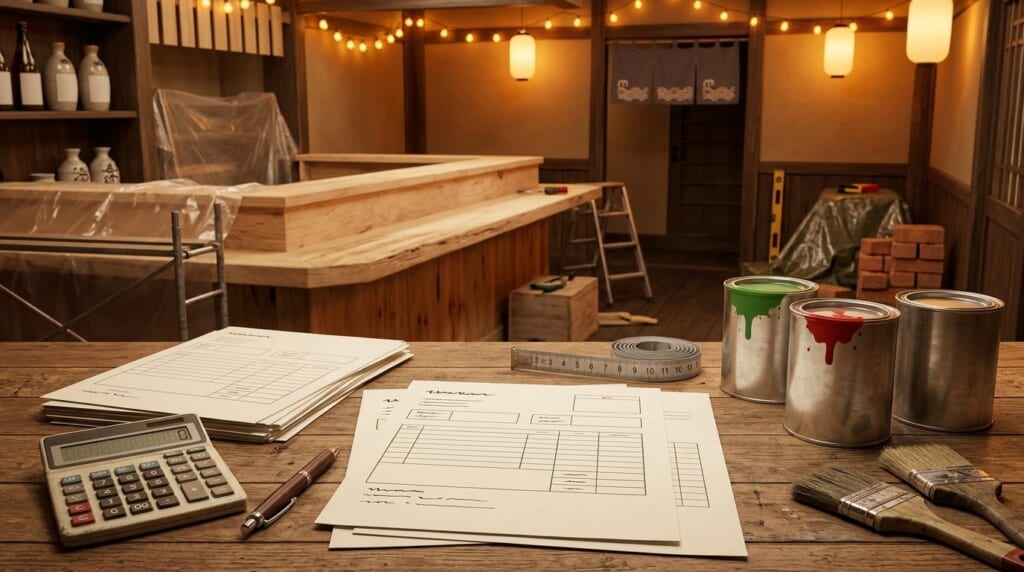
You’re putting together your startup loan application and are told you need quotes for the capital costs. You have a quote for the fit-out because a contractor is doing it. But what do you submit for the used chairs and lighting you’ll buy, or the paint for the walls you’ll do yourself? It’s a common question when preparing a loan.
A startup loan quote is a document showing what the capital costs you are borrowing for will be spent on and how much each will cost; the Japan Finance Corporation (JFC), a government-owned lender, requires quotes when you apply for capital costs. You can still apply for capital costs with a plan that includes used materials and DIY, but unless you gather quotes for the contracted work, the used materials and the DIY materials, and make the total match the “funds required” figure in your business plan, the amounts in your plan can look unsupported.
In this article, Tenpos Kawaguchi Interior Materials (Kawaguchi, Saitama; 1,254 m²) uses the JFC’s guidance to explain how to gather quotes for a plan that includes used materials and DIY.
Why does a startup loan need quotes?
A startup loan needs quotes so the lender can check what the capital costs will be used for and how much they come to. According to the JFC, a business founder applying for capital costs must submit quotes along with the business plan.
The “funds required and how they will be raised” section of the business plan has columns for the “quoted by” supplier and the amount for each line of capital costs. In the JFC’s sample plan for a restaurant, the deposit, interior and exterior fit-out, kitchen equipment, and fixtures and furnishings each list a supplier such as an estate agent or construction company. Quotes are the evidence behind the amounts in this section.
Sources: JFC, “For people planning to start a business” (application procedure); JFC, “Business plan self-check” (funds required and how they will be raised) (Japanese; checked 4 November 2026)
What does the loan assessment look at in your quotes?
The JFC’s business plan self-check asks applicants to confirm three points about their finance plan. Quotes relate directly to the first.
- Whether the quoted amounts are reasonable, checked by researching market prices or getting competing quotes
- Whether you have considered working capital after opening (such as enough to cover around six months of losses)
- Whether your plan relies too heavily on borrowing because your own funds are small
A plan that includes used materials and DIY can keep capital costs lower than one built only on new items and a single contractor. Lower capital costs mean that, with the same own funds, you rely less on borrowing and can set more aside for working capital, which also helps with the second and third points. How to build DIY into your plan is covered in “How much can you do yourself? Cutting restaurant fit-out costs with hybrid DIY”.
How should you get quotes for used materials?
For used materials, get a quote from the supplier you will buy from, listing items, quantities and amounts. Many used pieces are one-offs and you may not find enough of the same model, so check stock levels before asking for a quote.
- Ask for specific items and quantities: Rather than “one set of chairs”, have it show the chair model and number, and the table sizes and number.
- Separate shipping and transport: The cost differs depending on whether you collect from the store or have items delivered, so decide how they will be moved before getting the quote.
- Check how long the quote is valid: Once a used item is sold you can’t get the same one, so check the time until the loan decision and how long the items can be held.
- Back it up with market prices: If prices are published (such as online store listings), showing them alongside the quote makes it easier to explain that the amounts are in line with the market.
In our online store (371 items, all used, as of 7 October 2026), the median price was 8,800 yen including tax, and we publish price ranges by category in “Used Restaurant Interior Materials: Prices”. Tenpos Kawaguchi Interior Materials can issue quotes for use in a loan application. If you need one, settle the items and quantities first, then let us know when you visit or contact us. Because stock moves, also check how long the quote is valid and how long we can hold the items.
How should the DIY parts go into the plan?
For the work you will do yourself, include the cost of materials and tools as part of the capital costs. Your own labour isn’t money paid out, so leave it out of both the quotes and the plan.
| Example DIY task | What to include | How to get a quote |
|---|---|---|
| Painting dining-room walls and ceilings | Paint, primer and filler, masking materials, brushes and rollers | A quote or price list from a materials supplier or home centre |
| Putting up shelves | Shelf boards, brackets, screws, a stud finder | As above |
| Assembling and placing used furniture | The furniture itself, transport | A quote from the materials supplier |
| Hiring or buying tools | Tool hire or purchase costs | A hire shop’s price list or a retailer’s quote |
In the free-text section of the plan and at the interview, be ready to explain which stages you will do yourself, which you will give to craftsmen, and by when you will finish your own stages. The JFC says it visits the planned premises after the interview, so it helps to have a DIY plan you can explain with a schedule and actual progress.
How do you get quotes when craftsmen do part of the work?
If you bring in craftsmen only for licensed stages such as electrical, gas, water and drainage, get a quote from each. Because the quotes are split by stage, add them all up and check the total fit-out cost against the figure in your plan.
When work is split among craftsmen, it’s easy for a task you assumed was in one quote to turn out to be in none of them. Check which quote covers the tasks at the boundaries between stages, such as connecting power to equipment, connecting pipework and disposing of waste from the works.
In what order should you gather quotes?
Gathering quotes in this order helps avoid gaps and overlaps.
- Choose a candidate unit and settle the layout and seat count
- Split each stage into work for contractors or craftsmen, work you will do yourself, and used materials to buy
- Get quotes from at least two contractors or craftsmen
- Check stock of used materials, get a quote and discuss how long items can be held
- Get quotes for DIY materials and tools
- Make the total of all quotes match the “funds required” section of the business plan
Restaurants count as businesses under the hygiene-related industries category, which may require a letter of recommendation from the prefectural governor or a similar document; according to the JFC, however, no letter of recommendation is needed if the capital costs applied for are 5 million yen or less. Keeping capital costs down with used materials and DIY may mean you don’t need this document.
Start by splitting your capital costs into three groups (contracted work, used materials and DIY materials) and writing down who you will get each quote from. Once you know your suppliers, you can fill in the “funds required” section and have a plan ready to take to the lender.
How we can help you prepare your quotes
Tenpos Kawaguchi Interior Materials helps owners open by cutting purchase costs with used materials, doing what they can themselves, and bringing in licensed tradespeople only for the work that needs them.
- Choose used materials in person: On a single 1,254 m² floor, you can see and handle chairs, tables, lighting, doors, flooring and reclaimed timber. Everything on the shop floor has been inspected, cleaned and repaired in our own workshop.
- Quotes for your loan application: We can issue a quote listing the items, quantities and amounts of the materials you choose.
- Hold items until the loan decision: We agree how long to hold items around your works schedule and other timing. Trucks up to 4 tonnes can load on site, and we deliver anywhere in Japan from the store (large items and some locations by arrangement).
- Bring in tradespeople only where needed: We introduce craftsmen only for licensed work such as electrical, gas, water and drainage (no introduction fee for clients, free quotes, and you contract and pay the craftsman directly).
- Check your layout in 3D: Create a 3D floor plan with our staff in store, free of charge (by appointment; viewed on our in-store screen, not an official drawing).
Tenpos Kawaguchi Interior Materials
3-32-24 Sakashita-cho, Kawaguchi, Saitama / Open 10:00–19:00 every day (closed over the New Year holidays)
Tel +81-48-285-2027 / Parking available (trucks up to 4 tonnes, loading on site) / Payment: cash, card or PayPay
Talk to us about your build → Book a visit (materials, 3D plans) →