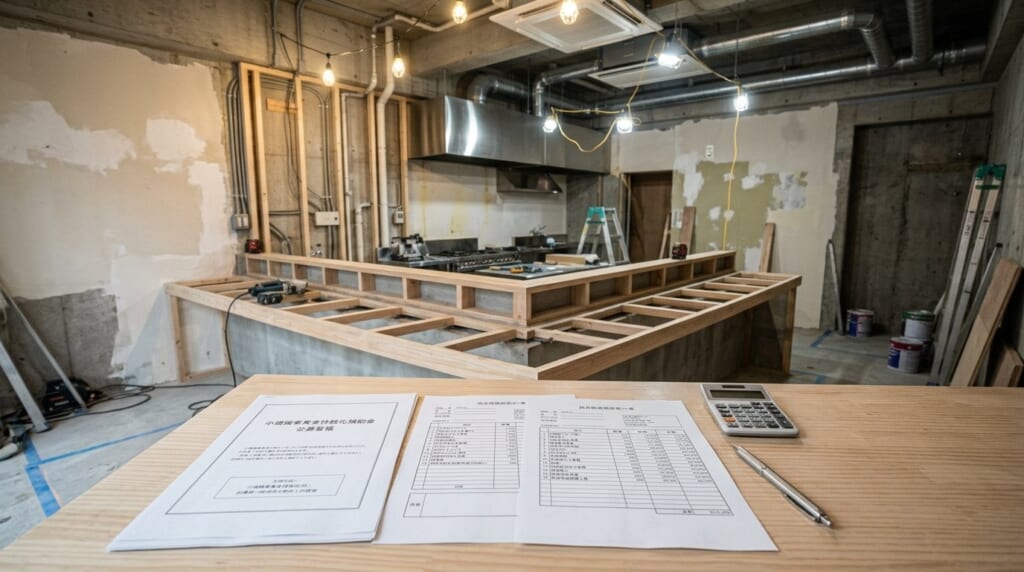
The fit-out quote is over budget. You’ve heard a subsidy would pay back two-thirds of the cost. If you apply now, will it be in time for works starting next month? It’s a hope we often hear when owners are planning their finances.
Japan’s Small Business Sustainability Subsidy is a government scheme that covers part of the cost of small businesses’ efforts to win new customers or work more efficiently, and it can cover a restaurant refit. However, both the general type and the startup type require you to be trading when you apply, so it can’t be used for the fit-out before you open. And because spending ordered or paid for before the grant decision doesn’t qualify, getting the timing wrong can mean receiving nothing after the work is finished.
In this article, Tenpos Kawaguchi Interior Materials (Kawaguchi, Saitama; 1,254 m²) uses the application guidelines for the round open as of 4 November 2026 to set out when the subsidy can cover fit-out costs and what to watch before applying.
Can the subsidy pay for the fit-out before you open?
No. The general-type guidelines exclude prospective founders who are not yet trading at the time of application, and state that even if you have filed a notice of commencement with the tax office, you are excluded if the start date on it is after the application date.
The startup type also requires your business start date to fall within the year before the application deadline, so it too is for businesses already trading. Under both types, only spending ordered or paid for after the grant decision date qualifies, so a plan to fund the pre-opening fit-out with this subsidy doesn’t work by design.
Fund the pre-opening fit-out from your own money and loans, and treat the subsidy as an option for a refit after opening that helps win new customers. How to build your startup budget is covered in “How much does it cost to open a restaurant?”.
How do the general and startup types differ?
The Small Business Sustainability Subsidy comes in a general type for small businesses already operating and a startup type for businesses within a year of opening. The main conditions for the round open as of 4 November 2026 are as follows.
| Item | General type (standard), round 20 | Startup type, round 4 |
|---|---|---|
| Eligibility | Small businesses trading at the time of application | Small businesses that started within the year before the application deadline and received support under a certified municipal startup support programme |
| Maximum grant | 500,000 yen (plus 500,000 yen under the invoice special case, or 1.5 million yen under the wage-increase special case) | 2 million yen (plus 500,000 yen under the invoice special case) |
| Subsidy rate | Two-thirds (three-quarters for loss-making businesses under the wage-increase special case) | Two-thirds |
| Application window | 5 November 2026 to 17:00 on 15 December 2026 | |
| Deadline to request the support plan | 4 December 2026 (from the local chamber of commerce or commerce association) | |
| Project completion deadline | 31 March 2028 | |
* Based on the application guidelines as of 4 November 2026. Conditions and dates change with each round, so check the latest guidelines before applying. You can’t apply for both types at the same time.
Sources: Small Business Sustainability Subsidy (general type, standard), round 20 guidelines (8th edition); Small Business Sustainability Subsidy (startup type), round 4 guidelines (8th edition) (subsidy secretariat for chamber of commerce areas; Japanese; checked 4 November 2026)
The subsidy is paid after the fact: during the project you pay all costs yourself first. Even after selection, the money only arrives after the grant decision, the project and the completion report, so allow for that gap in your cash flow.
Under which expense category does a refit qualify?
A refit can qualify under “outsourcing and subcontracting”. The guidelines give store refits, accessibility works and refurbishing customer toilets as examples of eligible expenses.
Only work that supports the project’s efforts to win new customers or work more efficiently qualifies. The refit must be tied to growing sales, for example “adding seats to take group bookings” or “removing a step so older customers can get in easily”; work not linked to winning customers or efficiency doesn’t qualify.
- Examples that don’t qualify: Work not linked to winning customers or efficiency, refitting the residential part of a combined home and shop, and building extensions or added floor space that count as acquiring property
- Never eligible under any category: Parking fees, guarantee deposits, security deposits, agency fees, and utilities
- Outsourced work of 500,000 yen or more (excl. tax): May count as restricted-disposal property, meaning that for a set period even after the project ends you can’t dispose of it without the secretariat’s approval.
Do used materials and equipment qualify?
Used items can qualify if they meet the conditions. For used items bought under the machinery and equipment category, the guidelines allow them only if all of the following are met.
- Unit price: Under 500,000 yen (excl. tax). If an item of 500,000 yen or more is split up to bring each part under that limit, the whole item is ineligible.
- Quotes: Quotes (quotations, price lists, etc.) for equivalent items from at least two used-goods dealers. Every used purchase needs two or more quotes, whatever the amount.
- Seller: Not bought from an individual or at auction, including online auctions.
- Repairs and faults: Repair costs don’t qualify, and if a faulty item can’t be used as planned, it becomes ineligible.
As examples of eligible machinery and equipment, the guidelines list chairs for older customers and baby chairs to attract older people and families with small children, and display cases for better hygiene or to save space. By contrast, simple like-for-like replacements that don’t open up new customers don’t qualify. If you want used chairs or fixtures to be covered, be ready to explain in the project plan what you are buying them for. Tenpos Kawaguchi Interior Materials can also issue quotes for used items for use in a subsidy application.
Source: Small Business Sustainability Subsidy (startup type), round 4 guidelines (8th edition), “Eligible expenses” (Japanese; checked 4 November 2026; the general type round 20 guidelines set the same conditions)
Why shouldn’t you start work before the grant decision?
Because any expense ordered, contracted, purchased or paid for (including advance payments) before the grant decision is ineligible. Even after selection, if you sign the works contract before the grant decision date, that work won’t be subsidised.
According to the guidelines, the grant decision can take around one to two months after selection is announced. With the wait from the application deadline to selection, and then from selection to the grant decision, plan for refit works to start well after you apply.
A subsidised refit goes in this order.
- Consult the local chamber of commerce or commerce association and ask for a business support plan
- Apply online (you need a GBizID Prime or similar account, which takes several weeks to obtain)
- Wait for the selection announcement
- Submit quotes and receive the grant decision
- Order and sign the works contract after the grant decision date
- Complete the works, pay, and submit the completion report
- The grant amount is confirmed and paid
What can you do before opening that helps with subsidies later?
Even though the subsidy can’t be used before opening, some preparation before you open puts you in a better position for subsidies and loans afterwards. One is to receive support under your municipality’s certified startup support programme.
A certified startup support programme is startup support (advice sessions, startup seminars and the like) run by a municipality certified by the national government, working with chambers of commerce and others. In Kawaguchi, where our store is, the city issues a certificate of support once you have covered four areas (management, finance, staff development and winning customers) over at least one month and four or more sessions.
According to Kawaguchi City, the certificate brings reduced registration tax when setting up a company in the city, special terms on startup credit guarantees, a lower interest rate on the Japan Finance Corporation’s new business and startup support loan, and eligibility for the startup type of the sustainability subsidy. Because it takes at least a month, starting while you are still looking for a unit widens your options after opening.
* Requirements and benefits differ by municipality. Check with the municipality where you plan to open.
Source: Kawaguchi City, “Startup support programme” (Japanese; checked 4 November 2026)
Start by writing down your opening date and when you might refit, and review your finance plan on the basis that the subsidy only applies to a refit after opening. For the pre-opening fit-out, plan to bring the cost itself down by combining used materials, DIY and calling in craftsmen only for some of the work.
How we can help cut fit-out costs without subsidies
Tenpos Kawaguchi Interior Materials helps owners open by cutting purchase costs with used materials, doing what they can themselves, and bringing in licensed tradespeople only for the work that needs them. Since the pre-opening fit-out can’t use the subsidy, the answer is to combine ways of bringing the cost itself down.
- Choose used materials in person: On a single 1,254 m² floor, you can see and handle chairs, tables, lighting, doors, flooring and reclaimed timber. Everything on the shop floor has been inspected, cleaned and repaired in our own workshop.
- Hold items to suit your build schedule: We agree how long to hold items around your works schedule. Trucks up to 4 tonnes can load on site, and we deliver anywhere in Japan from the store (large items and some locations by arrangement).
- Bring in tradespeople only where needed: We introduce craftsmen only for licensed work such as electrical, gas, water and drainage (no introduction fee for clients, free quotes, and you contract and pay the craftsman directly).
- Check your layout in 3D: Create a 3D floor plan with our staff in store, free of charge (by appointment; viewed on our in-store screen, not an official drawing).
- Using the subsidy for a refit after opening: We can issue the quotes you need when buying used items under the sustainability subsidy. Whether an item qualifies depends on your project plan and the conditions in the guidelines.
Tenpos Kawaguchi Interior Materials
3-32-24 Sakashita-cho, Kawaguchi, Saitama / Open 10:00–19:00 every day (closed over the New Year holidays)
Tel +81-48-285-2027 / Parking available (trucks up to 4 tonnes, loading on site) / Payment: cash, card or PayPay
Talk to us about your build → Book a visit (materials, 3D plans) →